I woke up shortly after midnight today to quite a shaking, as did a lot of my friends; there was a 6.2 earthquake near the Costa Rica-Panama border, about 135 miles southest of San Jose, that was felt nationwide. Whew, that's a big one, and according to the news it lasted a minute or so—a long time when things are rolling. A few people I've talked with said stuff fell off their walls and shelves, but thankfully we didn't have any problems.
At first I wasn't sure if it was quaking because I was so tired. The rain was pouring and the wind blowing so hard that doors were banging around in their frames, water was blowing in under shut windows in the sills, and air was howling through the cracks. (It is still howling—we must be nearing December!)
Just another day in paradise!
Wednesday, November 19, 2008


Monday, November 03, 2008
Boats, Arrows, and Monkey Tails (Our Adventure with the BriBri)
 To continue the story of our trip to the Caribbean … we left off having lunch with our Spanish friends the Muelas family. Álvaro explained he had a work-related meeting with someone from the government. The man told him about a trip we should take—and he would arrange it for us—to an indigenous BriBri village, located on a reserve in the heart of the remote and lush tropical forest in the Talamanca mountains. The more we learned about the adventure, the more we wanted to go and realized what a once-in-a-lifetime opportunity it was. So we booked another night at the hotel and joked with our friends about coming back in one piece from the trip.
That night we bought hats for Erin and me and called Álvaro’s contact with our shoe sizes so they could get the tall boots we’d need to wear on our journey.
This was the real deal—authentic in every way. Not a lick of English was spoken by the BriBri, no brochures or T-shirts were available at their village. It was just us in their environment and an incredible adventure! Whenever you’re ready, you can watch a slideshow of our day.
The BriBri
The BriBri Indians (pronounced "bree bree") are indigenous people in the Caribbean coastal areas and mountainous rainforest of northern Panama and southern Costa Rica. Through traditional, non-invasive methods of agriculture, hunting, fishing, and use of products from the rainforest, the Bribri maintain a respectful relationship with the natural environment that sustains them. They wear western clothing and speak Spanish in addition to their native BriBri—and we learned how important it is for them to preserve their rich cultural heritage for future generations.
 Start of the journey
We got up early (I spotted a poison dart frog hopping around—cool!) and drove to the town of BriBri to pick up long socks for the girls and water to carry in our packs. BriBri is on the Sixaola River—the border between Costa Rica and Panama—and we were able to look across the river at Panama for much of the trip.
After driving for about an hour on non-paved roads (rough terrain!) and through three small rivers over the roads (thank goodness we had the Rav4!), we arrived in Bambú, the closest commercial town to the reserve. We parked at the pulpería (a small general store) next to the police post where we donned knee socks and boots. The girls started chasing chickens around the buildings as we met Heliodoro, the boatman from the Yorkín community who would take us to the BriBri village.
 We piled onto handmade wooden benches in a motorized dugout. I noticed duct tape on the boat bottom where a little water was gurgling up and tried to keep my boot over it to minimize the occasional water bailing our boatman had to do.
We traveled through the remote, tropical jungle surrounded by the sounds of the Yorkín River, birds and animals. We saw beautiful blue morphos floating through the air and many birds including several kingfishers and stunning tanagers whose brilliant red feathers stood out against the verdant landscape.
We were going upstream and the river was shallow and rushing in places. While the experienced boat driver knew exactly where to take us, at times he and the boatman in the front had to use long poles to push against the river bottom to keep us from running aground. At one point they had to get out and push our dugout through the shallows.
 One of the most exciting parts of the boat trip is that we went into Panama. Lush Costa Rican jungle towered up steep cliffs to our right, while tree branches hung over the water to Panama on our left, so close we could reach out and touch them. Our passports aren’t stamped, but we’ve all been in Panama now.
About an hour later we reached the village set on the hillside, seemingly in the middle of nowhere. Once our boat stopped moving we felt the sun on us; the day was quickly heating up, and I was so glad we all had hats.
We trekked up the hill to see the very modest, one-room schools and begin the 20-minute hike through rainforest and mud to the village’s central building—the Stibrawpa Lodge. During our walk we learned about the area’s trees, plants, and crops. At one point the guide broke off a stalk of palmito for us to taste. Hygiene aside, we passed it around and everyone tried a bite. We also saw cacao fruit and a tall plant with a curly top called “monkey’s tail.”
 Snack time
We removed our muddy boots at the lodge and left them at the bottom of the stairs, wearing our socks in the building which was like a large, wood platform. Everyone sat at one of the two long tables for a much-needed drink of watery juice (just squeezed from the fruit in the village), lychee fruit, and homemade bread made of homegrown bananas with a small amount of flour just to keep it together.
I was excited when our guide split a cacao open for us to see. The inside was filled with seeds covered in white flesh. Everyone took a seed and sucked on it. It had an interesting flavor that was nothing like chocolate.
We walked around the corner from the sitting/eating area and saw the village kitchen where a chicken (likely one of the many that roam the area) was cooking over a wood fire—the way all foods are cooked at the lodge, since there is no electric or gas stove.
 Over the river
We walked to a nearby river to find a rickety hanging bridge about 20 feet above the rock-filled water. I was reluctant to climb the stairs and cross, but this was my Survivor Costa Rica moment and I was determined not to miss a thing—so I did it. I let everyone go before me (Álvaro teased me by swinging the bridge and barely lived to tell about it) but my faithful husband stayed behind me and offered encouragement. I gripped the guide wires the entire time and later learned that Dan was taking pictures and never touched the sides. What a guy.
On the other side of the bridge our guide showed us some towering, poisonous trees. He told us a few other things (all in Spanish, of course) but I was distracted watching the girls run around and telling them not to touch the trees. Then finally I asked if we were going swimming here (we had all worn swimsuits under our clothes and it was hot!) and was told no, we’d cross back to the other side. The bridge again? Already? I really just wanted to get in the water—but not by falling into it!
 Cooling off
This river was clear, full of huge stones, and cold—but wow did it feel good! A refreshing swim was exactly what we needed. After about 20 minutes we climbed out of the river (quite literally) and brushed the dirt from our feet as best we could before putting our socks and boots back on.
 Slings and arrows
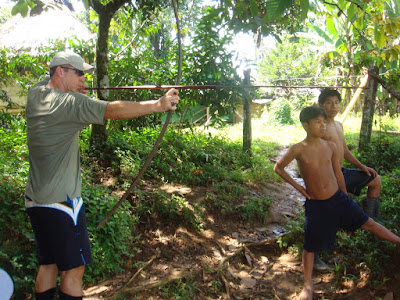
On the river bank we met some BriBri boys who wanted to teach us how they shoot their handmade bows and arrows. These handsome kids had such beautiful smiles and manners, it was a pleasure to watch them shoot the target (hanging fruit) and then let us take turns.
Dan’s dad was a national champ archer and taught Dan to shoot when he was little, so I wasn’t surprised when Dan’s rudimentary arrows grazed the target several times. The girls took aim too, and I was proud of them for trying—Erin said it was very hard.
 Tasting monkey tails
By this point our stomachs were growling, so we returned to the lodge for a typical, delicious Bribri meal. We had the chicken we saw cooking earlier, fresh palmito, rice and beans, plantain and banana, and fried monkey tail (remember the plant we’d seen earlier on the trail?). Large banana leaves lined the serving bowls and covered our plates which were actually smooth, thick slabs of wood. Nobody was shy about taking seconds and even thirds, we were so hungry and the meal tasted great.
A lesson about the Bribri
Daisy, a BriBri Indian, taught us more about her village. Years ago, the Yorkín women united to form the indigenous association Stibrawpa, intended to diversify their means of production, particularly agriculture, and develop new sources of income while preserving their culture. It’s interesting that while the men are involved in decision-making for the Bribri, the women lead the village council and have directive control.
Now several Bribri families in the association grow a variety of crops as sustainable agriculture and also sell organic bananas and cacao, and the women create indigenous handicrafts for additional income.
Daisy explained to us that they have no medical care, but a doctor comes by every couple of weeks. Additionally, while the government has offered to bring electricity to them, they don’t want it; the concern is that it will drastically change their way of life for the worse and lure their children away from the culture they’re working so hard to preserve (an effort that includes Bribri language courses for the kids). They do have a couple of cold-water showers and two toilets near the lodge, but make no mistake that these people live very simply and rustically.
The Bribri live in small houses with roofs made of traditional palm thatch from primary rainforest. They sleep in hammocks or on the floor, with everyone in the same room. Some houses are isolated and the children have to walk a long way—even an hour or two—to school.
 What most struck me was that these are happy, peaceful people. They work very hard for their survival but seem cheerful and content with their lives. They care for their environment, their families, and showed a genuine kindness to us. Despite the seemingly insurmountable differences in language, upbringing, and culture, I felt a connection to these women and great admiration for them. It was yet another lesson I’ve learned in Costa Rica about perspective in life.
 Making chocolate
On to the most anticipated part of the day … making chocolate from the cacao, which is sacred to the BriBri. We learned how cacao seeds are dried and then toasted. The warm seeds tasted like bitter chocolate. A young man brought out a smooth, heavy stone and showed us how to crush the seeds with it. It’s a lot harder than it looks! And wow, the seeds smelled really good when we crushed them.
 Once everything was in tiny pieces, he rapidly shook the bowl to separate the meat from the shells. Then he put the cacao into a hand grinder and everyone took a turn with the handle. What came out and into the bowl looked like thick, melting chocolate. A few of us couldn’t wait and dipped our fingers in for a taste. It was bitter but absolutely chocolate.
We took the chocolate inside the lodge where some of it was mixed with hot water and sugar to drink—a traditional BriBri-style hot chocolate—while the rest was combined with a can of sweetened condensed milk. Oh my gosh, please, this was absolutely some of the most amazing chocolate ever. Thankfully we are all good friends because most of us (especially Isa, Erin, and I) were dipping our fingers into the sweet chocolate, licking them off (all while animatedly discussing the deliciousness of it all) and then diving back in. True dark chocolate is considered to be about 50 percent cacao; we were eating 100 percent cacao (less when mixed with the milk). This was the freshest chocolate ever and wow, sooooooo good!!
 The return trip
Late afternoon, we headed back to our boat and to Bambú. The river’s current was with us as we traveled downstream in the dugout, so the trip was considerably quicker than our first journey yet equally as beautiful.
It felt great to take off our rubber boots and long socks when we got to our cars. We said our goodbyes and headed back to Punta Uva with plans … everyone needed a shower (wow, were we dirty—especially Lauren!) and a rest, and then we’d meet up for our 7pm reservations at La Pecora Nera. Yep, again—because after our day—we made it!—we decided to enjoy the luxury of a fantastic, candlelit Italian dinner at a beautiful restaurant with our wonderful friends. We are truly blessed to have met the Muelases and spent this unique experience with them. It was a day none of us will ever forget and one that left a lasting impact on our lives.
Sunday, October 26, 2008
Caribbean calling
By the time we hit mid-October in the rainy season, we are all desperate for sunny skies and warm, dry breezes. The girls had off a few days from school at CDS, so we fled the waterlogged valley for the beautiful Caribbean.
It’s hard to decide what to blog about this trip—there were so many small moments we’ll always remember, yet journaling them all would fill pages. With that in mind, here are some highlights of our time on the coast and a photo album (best viewed as a slideshow) of the first few days of our trip ...
We set out on a sopping wet Thursday morning. About 20 kilometers north of San Jose, we drove through the mountainous Braulio Carillo National Park, an area beyond lush—it’s a gorgeous tropical rainforest with rushing waterfalls, flowers, and towering trees.
Once we came down from the mountains, we bid a big ADIOS to the rain! The rest of the trip was relatively flat, taking us over numerous rivers and past bunches of banana plantations, where the fruit hung in blue bags from tree after tree. The scenery wasn’t like anything we’d seen yet in Costa Rica, but then again, the Caribbean is different from the rest of the country in many ways.
 Though just a few hours from the central valley, the Caribbean seems worlds away. The coast is still relatively undeveloped and, because it was so remote for so long, has its own unique culture. There are reserves of indigenous peoples here, and many of the area’s inhabitants are descendants of Jamaican immigrants who came to work on the railroads and banana plantations. These immigrants shaped the culture, and the area has a Jamaican flavor in its music (plenty of reggae), food (much spicier and less-Tico), language (some speak an English-based patois which I find harder to understand than Spanish), drug culture (yes, we smelled marijuana while walking down a beachfront street in Puerto Viejo), and even style of dress (plenty of dreadlock-sporting Rastafarians here).
Eventually we passed the port city of Limón. This is where the container ships come in and where our household goods first landed in Costa Rica. Limón is the largest town on the country’s east coast—a rough-looking place that ships millions of pounds of bananas to the world each year. It’s not much of a tourist destination, and we drove along the city’s edge to the south, along the coast.
 We passed by Cahuita and drove into Puerto Viejo, then another eight kilometers to Punta Uva. It’s an understatement to say the drive is bumpy and jarring from Puerto Viejo to the south. The roads here are “paved” in tiny sections—most of the road is dusty and full of rocks and massive potholes. This is hands-down the worst stretch of driving we’ve ever done in Costa Rica. Our trusty RAV4 took quite a beating on this trip.
 Finally, we reached our hotel (a compound of single-story buildings with four rooms apiece) and headed right to the beach where we spent much of our time during the next few days. This is said to be one of the best beaches on the Caribbean side of Costa Rica and was refreshing and clear. There was plenty of coral and fish for snorkeling, and—perhaps most fun for everyone—we got to play with a lot of CDS families we know who were also escaping the valley for drier climes and beautiful beaches.
Our first night we had dinner with our friends the Irlenborns at Maxi’s in Manzanillo. Maxi’s is a popular hang-out about five kilometers south of Punta Uva, and the drive is on a two-lane road lined with dense jungle. The restaurant sits at the dead-end of a tiny town and the last settled area in Costa Rica before entering a wildlife reserve that encompasses a few kilometers between Manzanillo and Panama. We had good food and lots of fun with our friends in addition to spotting a bunch of geckos on the ceiling and a few cats prowling around, too. (We noticed there were a lot of cats in this part of the country, actually, which I loved since I still miss my buddy Charlie.)
Sleeping was comfortable since we stayed in one of the few places on the beach with air conditioning. (No mosquito nets for us!) I still woke up each night though to the sounds of howler monkeys traveling through the jungle. I’ve mentioned these vocal animals before, but it bears mentioning that the calls of a troop can carry for miles and are loud enough to wake me out of a sound sleep.
We had breakfast at the hotel’s open-air restaurant each day. One morning while eating her eggs, Erin spotted a sloth across the path near our room. Sloths rarely come down from their treetop homes, so this was a great surprise. We walked over to watch the three-toed creature s-l-o-w-l-y pull itself with its hands over the land and up the giant tree right outside our room. It was a fortunate opportunity to see this.
A few times on this vacation we drove into Puerto Viejo, which is truly Caribbean—steamy, sandy, and laid-back. It’s really hot in this surfers' hang-out, and people take life more slowly here. Between Punta Uva and Puerto Viejo we saw a lot of people walking and riding bicycles, nobody in much of a hurry to get anywhere.
 On Friday at the beach, we met up with our friends the Muelas family from Spain. We snorkeled and swam with them, and that evening the eight of us had reservations at a fabulous restaurant in Cochles called La Pecora Nera—a mouthwatering taste of Italy on the edge of the Costa Rican jungle. Many travel guides and travelers agree that this beautiful, open-air restaurant has the best Italian food in the country. The owner is this exuberant, young Italian guy who was not only our chef but also part-time waiter who advised us—with a flourish—on what to order that night. It was a long, leisurely, and fantastic dining experience with a family whose company we truly enjoy.
The following morning we walked along the hotel path that leads to the main road. Surrounded by jungle, we saw blue morphos (love them!), turtles, crabs, and birds. The foliage here is so thick and wild, Dan commented that a person wouldn’t need to walk far into it before he or she might never come out.
Of course we parked ourselves at the beach after the walk for hours of swimming and relaxing in beach chairs under the palm trees (ah, heavenly!). We went to lunch with our Spanish friends that afternoon and, while there, decided to extend our vacation to do something unique, adventurous, and amazing. That story is to come in the next blog entry and will tell of one of our most memorable days here in Costa Rica!
It’s hard to decide what to blog about this trip—there were so many small moments we’ll always remember, yet journaling them all would fill pages. With that in mind, here are some highlights of our time on the coast and a photo album (best viewed as a slideshow) of the first few days of our trip ...
We set out on a sopping wet Thursday morning. About 20 kilometers north of San Jose, we drove through the mountainous Braulio Carillo National Park, an area beyond lush—it’s a gorgeous tropical rainforest with rushing waterfalls, flowers, and towering trees.
Once we came down from the mountains, we bid a big ADIOS to the rain! The rest of the trip was relatively flat, taking us over numerous rivers and past bunches of banana plantations, where the fruit hung in blue bags from tree after tree. The scenery wasn’t like anything we’d seen yet in Costa Rica, but then again, the Caribbean is different from the rest of the country in many ways.
 Though just a few hours from the central valley, the Caribbean seems worlds away. The coast is still relatively undeveloped and, because it was so remote for so long, has its own unique culture. There are reserves of indigenous peoples here, and many of the area’s inhabitants are descendants of Jamaican immigrants who came to work on the railroads and banana plantations. These immigrants shaped the culture, and the area has a Jamaican flavor in its music (plenty of reggae), food (much spicier and less-Tico), language (some speak an English-based patois which I find harder to understand than Spanish), drug culture (yes, we smelled marijuana while walking down a beachfront street in Puerto Viejo), and even style of dress (plenty of dreadlock-sporting Rastafarians here).
Eventually we passed the port city of Limón. This is where the container ships come in and where our household goods first landed in Costa Rica. Limón is the largest town on the country’s east coast—a rough-looking place that ships millions of pounds of bananas to the world each year. It’s not much of a tourist destination, and we drove along the city’s edge to the south, along the coast.
We passed by Cahuita and drove into Puerto Viejo, then another eight kilometers to Punta Uva. It’s an understatement to say the drive is bumpy and jarring from Puerto Viejo to the south. The roads here are “paved” in tiny sections—most of the road is dusty and full of rocks and massive potholes. This is hands-down the worst stretch of driving we’ve ever done in Costa Rica. Our trusty RAV4 took quite a beating on this trip. Finally, we reached our hotel (a compound of single-story buildings with four rooms apiece) and headed right to the beach where we spent much of our time during the next few days. This is said to be one of the best beaches on the Caribbean side of Costa Rica and was refreshing and clear. There was plenty of coral and fish for snorkeling, and—perhaps most fun for everyone—we got to play with a lot of CDS families we know who were also escaping the valley for drier climes and beautiful beaches.
Our first night we had dinner with our friends the Irlenborns at Maxi’s in Manzanillo. Maxi’s is a popular hang-out about five kilometers south of Punta Uva, and the drive is on a two-lane road lined with dense jungle. The restaurant sits at the dead-end of a tiny town and the last settled area in Costa Rica before entering a wildlife reserve that encompasses a few kilometers between Manzanillo and Panama. We had good food and lots of fun with our friends in addition to spotting a bunch of geckos on the ceiling and a few cats prowling around, too. (We noticed there were a lot of cats in this part of the country, actually, which I loved since I still miss my buddy Charlie.)
Sleeping was comfortable since we stayed in one of the few places on the beach with air conditioning. (No mosquito nets for us!) I still woke up each night though to the sounds of howler monkeys traveling through the jungle. I’ve mentioned these vocal animals before, but it bears mentioning that the calls of a troop can carry for miles and are loud enough to wake me out of a sound sleep.
We had breakfast at the hotel’s open-air restaurant each day. One morning while eating her eggs, Erin spotted a sloth across the path near our room. Sloths rarely come down from their treetop homes, so this was a great surprise. We walked over to watch the three-toed creature s-l-o-w-l-y pull itself with its hands over the land and up the giant tree right outside our room. It was a fortunate opportunity to see this.
A few times on this vacation we drove into Puerto Viejo, which is truly Caribbean—steamy, sandy, and laid-back. It’s really hot in this surfers' hang-out, and people take life more slowly here. Between Punta Uva and Puerto Viejo we saw a lot of people walking and riding bicycles, nobody in much of a hurry to get anywhere.
On Friday at the beach, we met up with our friends the Muelas family from Spain. We snorkeled and swam with them, and that evening the eight of us had reservations at a fabulous restaurant in Cochles called La Pecora Nera—a mouthwatering taste of Italy on the edge of the Costa Rican jungle. Many travel guides and travelers agree that this beautiful, open-air restaurant has the best Italian food in the country. The owner is this exuberant, young Italian guy who was not only our chef but also part-time waiter who advised us—with a flourish—on what to order that night. It was a long, leisurely, and fantastic dining experience with a family whose company we truly enjoy.The following morning we walked along the hotel path that leads to the main road. Surrounded by jungle, we saw blue morphos (love them!), turtles, crabs, and birds. The foliage here is so thick and wild, Dan commented that a person wouldn’t need to walk far into it before he or she might never come out.
Of course we parked ourselves at the beach after the walk for hours of swimming and relaxing in beach chairs under the palm trees (ah, heavenly!). We went to lunch with our Spanish friends that afternoon and, while there, decided to extend our vacation to do something unique, adventurous, and amazing. That story is to come in the next blog entry and will tell of one of our most memorable days here in Costa Rica!
Sunday, October 12, 2008
She's acclimated
 It was 75 degrees in our house when I walked through the family room and saw Lauren wearing her knit cap and snuggled under a Mickey Mouse sleeping bag.
"It's kinda cold, Mom."
Bet she's really gonna like that first chilly day we get in Ohio next year!
Saturday, October 11, 2008
¿Se habla inglés?
You know what's weird? Last night I was browsing through TV channels while waiting for Dan's taxi to arrive from the airport and I stopped on an interesting-looking British movie. As I started watching it, I realized I was reading the subtitles. And not just because I can't help reading them—which is often the case—but because I had to.
Yeah, the movie was in English, but in all fairness to me this wasn't the Queen's English. The accents of a couple of characters were so thick I had a hard time understanding what was being said. So I used subtitles. Spanish subtitles. To understand a movie in English.
Once I realized what I was doing I felt kinda freaked out and turned the TV off in favor of a book.
A few times I've watched French movies by reading the Spanish subtitles, but usually after a while my brain gets tired or I get bored. Of course this is almost always at night and is a significant violation of the English-only television-viewing zone rules of the house, so I should know better!
Yeah, the movie was in English, but in all fairness to me this wasn't the Queen's English. The accents of a couple of characters were so thick I had a hard time understanding what was being said. So I used subtitles. Spanish subtitles. To understand a movie in English.
Once I realized what I was doing I felt kinda freaked out and turned the TV off in favor of a book.
A few times I've watched French movies by reading the Spanish subtitles, but usually after a while my brain gets tired or I get bored. Of course this is almost always at night and is a significant violation of the English-only television-viewing zone rules of the house, so I should know better!
Tuesday, October 07, 2008
Random thoughts on late-night TV
Sometimes near the end of the day, Dan and I relax in front of the TV—maybe watch a little news or catch the second half of CSI. More often than not we have a TV language rule by this hour: nothing in Spanish. No soccer (definitely no soccer!), no dubbed sitcoms, no Latin American talk shows—nada. It’s an English-only television-viewing zone, and thankfully—with gratitude to the magic button on our remote that removes dubbing from certain shows—we have a handful of decent American channels from which to choose.
So what if we’ve already seen every episode of Seinfeld a zillion times? Who cares that the rerun of Law & Order is from the days of Lenny Briscoe and Ben Stone? We can get some of these old shows plus Fox News and CNBC—which is what we most commonly watch—and in a pinch, we’ll even watch local news for Denver, the city that provides our network feed.
Dan’s traveling a lot this month, so I’ve been reading at night or hanging out here on the computer hoping to catch him on IM. The no-English TV stuff has been less of an issue. (Though I gotta admit, I did catch an episode of Growing Pains—circa 1987—the other night. Too bad it wasn’t the episode with Brad Pitt, but I still enjoyed the Seavers’ antics. And Wow! Check out that big ‘80s hair!)
Of course mostly what’s on TV now is election coverage stuff, and we’re starting to burn out on that a bit. (We’ve already voted—and yeah, it’s important to stay on top of what’s going on, but it’s not like I’m gonna call the United States and ask to change my ballot, right?) Tonight I’ll watch the debate and all the pundits taking jabs at the candidates and each other afterwards. It’s almost like I’m rubbernecking after an accident on I-75. I want to look away for a while but just can’t.
Overall, we watch less TV here than in the US. We don’t have DVR, we don’t have high def (which we desperately miss during football season) and we have a much smaller selection of choices when it comes to programming. I miss the DVR (because really, who wants to watch commercials?) and certainly we are looking forward to the return of HD when we move back to the States, but other than that, the limited selection is OK. Though I admit we draw the line for watching American shows at MacGyver. (Talk about hair styles of the ‘80s!)
I really do wish we could get the US version of SportsCenter on ESPN, but I won't complain (at least not too loudly or too often!).
So what if we’ve already seen every episode of Seinfeld a zillion times? Who cares that the rerun of Law & Order is from the days of Lenny Briscoe and Ben Stone? We can get some of these old shows plus Fox News and CNBC—which is what we most commonly watch—and in a pinch, we’ll even watch local news for Denver, the city that provides our network feed.
Dan’s traveling a lot this month, so I’ve been reading at night or hanging out here on the computer hoping to catch him on IM. The no-English TV stuff has been less of an issue. (Though I gotta admit, I did catch an episode of Growing Pains—circa 1987—the other night. Too bad it wasn’t the episode with Brad Pitt, but I still enjoyed the Seavers’ antics. And Wow! Check out that big ‘80s hair!)
Of course mostly what’s on TV now is election coverage stuff, and we’re starting to burn out on that a bit. (We’ve already voted—and yeah, it’s important to stay on top of what’s going on, but it’s not like I’m gonna call the United States and ask to change my ballot, right?) Tonight I’ll watch the debate and all the pundits taking jabs at the candidates and each other afterwards. It’s almost like I’m rubbernecking after an accident on I-75. I want to look away for a while but just can’t.
Overall, we watch less TV here than in the US. We don’t have DVR, we don’t have high def (which we desperately miss during football season) and we have a much smaller selection of choices when it comes to programming. I miss the DVR (because really, who wants to watch commercials?) and certainly we are looking forward to the return of HD when we move back to the States, but other than that, the limited selection is OK. Though I admit we draw the line for watching American shows at MacGyver. (Talk about hair styles of the ‘80s!)
I really do wish we could get the US version of SportsCenter on ESPN, but I won't complain (at least not too loudly or too often!).
Friday, October 03, 2008
The whirlybird coincidence
My friend Joelle and I were returning from a shopping trip when we saw a neighbor out walking her dog. We stopped to chat, but our brief conversation was interrupted when a thunderous, low-flying helicopter flew right over Joelle’s car and—to our complete surprise—landed in an empty lot right here in the neighborhood.
We all looked at each other in disbelief, and then of course I had to get out and take a couple of pictures—because really, this was a very unusual thing. A man got out of the helicopter and hurried down the side of the field; then the pilot took off. It all happened very quickly.

Later we told friends about the helo, and everyone agreed that it landing in this area was a weird occurrence. We all wondered what the helicopter was doing in our neighborhood and who it belonged to.
Fast forward to a couple of days later … Dan, the girls, and I went to a surprise birthday party for our friend Angie. The fiesta was up in the hills of Escazú at the home of friends Angie knows from church.
Shortly after the party began, we introduced ourselves to the hosts, David and Laurie. We found out that they are developing houses in our neighborhood, just down the street from here. I told David about the crazy helicopter sighting and asked if he had an idea what was going on.
He had an idea, all right. A really clear idea. Because—as it turns out—David is the helicopter pilot. He was dropping off an employee to work on the construction site in the housing development.
Before we even moved to Costa Rica, we learned in our cultural training and from other Ticos that one has to be very careful not to insult other Costa Ricans or businesses or restaurants, because Costa Rica is a little country, and at times it seems everybody knows (or is related to!) everybody else. Someone is always a friend of a friend, a cousin, a best amigo … I mean really, here we are not even Ticos and it is just such a funny coincidence that we met the helicopter pilot and figured out the connection to his landing in our neighborhood so quickly. In Costa Rica, it really is a small world, after all.
He was pretty amused that I took pictures of his helicopter, too!
¡ Pura coincidencia!
We all looked at each other in disbelief, and then of course I had to get out and take a couple of pictures—because really, this was a very unusual thing. A man got out of the helicopter and hurried down the side of the field; then the pilot took off. It all happened very quickly.
Later we told friends about the helo, and everyone agreed that it landing in this area was a weird occurrence. We all wondered what the helicopter was doing in our neighborhood and who it belonged to.
Fast forward to a couple of days later … Dan, the girls, and I went to a surprise birthday party for our friend Angie. The fiesta was up in the hills of Escazú at the home of friends Angie knows from church.
Shortly after the party began, we introduced ourselves to the hosts, David and Laurie. We found out that they are developing houses in our neighborhood, just down the street from here. I told David about the crazy helicopter sighting and asked if he had an idea what was going on.
He had an idea, all right. A really clear idea. Because—as it turns out—David is the helicopter pilot. He was dropping off an employee to work on the construction site in the housing development.
Before we even moved to Costa Rica, we learned in our cultural training and from other Ticos that one has to be very careful not to insult other Costa Ricans or businesses or restaurants, because Costa Rica is a little country, and at times it seems everybody knows (or is related to!) everybody else. Someone is always a friend of a friend, a cousin, a best amigo … I mean really, here we are not even Ticos and it is just such a funny coincidence that we met the helicopter pilot and figured out the connection to his landing in our neighborhood so quickly. In Costa Rica, it really is a small world, after all.
He was pretty amused that I took pictures of his helicopter, too!
¡ Pura coincidencia!
Saturday, September 27, 2008
We cast our ballots
 On the heels of the presidential debate in Mississippi, I imagine many Americans are eager to vote and anticipating trips to the polls in November. Not us! Dan and I—along with a mess of other US citizens—voted for the US president today in downtown San José. What a fascinating and unusual experience!
We left home this morning to navigate our way through the crazy SJ traffic and a city without street signs. Our friends the Reidys were close behind us, and we had no problem getting to the parking lot just down from the hotel. (Many thanks to our friend Dustin, who gave us some excellent directions to the Holiday Inn where we voted!)
A group of Americans called Democrats Abroad generously hosted the vote, open to members of all parties.
When we got to the hotel's third floor, where the voting was held, I realized how unusual it was to be in such a large group of Americans here in Costa Rica—most of us clutching passports, US driver licenses, and social security cards. We waited in a short line with our friends until we were able to vote.
There were no polling booths, levers to pull, or hanging chads today. Instead we voted by federal write-in absentee ballot. Inside a conference room were several large, round tables, each seating about eight voters and a couple of facilitators. People entered in shifts as the facilitators helped us vote.
Dan and I began by addressing federally-issued envelopes to the Butler Country Board of Elections in Hamilton, Ohio. Then we had to enter a bunch of personal info and make a voter's declaration/affirmation, stating we are US citizens who may legally vote in the general election.
Finally, we voted, actually writing in the names of our candidates. Someone asked Dan how to spell Palin, while I heard an elderly woman ask for a reminder of Biden's last name. There wasn't really any secrecy to it at all—I could easily look next to me on both sides and see who my neighbors were voting for, but that was OK. It was just such a different experience and I felt very excited about doing something so thoroughly American as voting for our president.
 Once everything was filled out I folded my ballot, placed it in a special "security envelope," and sealed it. The sealed security envelope and the voter's declaration/affirmation were then put into another envelope (the one addressed to Hamilton, Ohio) and sealed.
Lastly, Dan and I walked over by the windows to place our envelopes into a box and we were done. Off to the US go our ballots!
 The ride home was slow but interesting as Dan drove and I navigated (sort of!) our way down narrow streets cramped with taxis, buses, and crowds of Saturday morning shoppers. I thought I'd include this picture Erin took to show you how close behind us the buses like to be (nearly touching our car, here). Finally we got through the congestion and were on our way to Multiplaza Escazú for some lunch, pleased that we voted and that the girls, once again, were able to see democracy in action and how much we value our right as Americans to vote.
(Of course we didn't let Lauren drive—she is 10 years away from driving legally in Costa Rica, actually, with the driving age being 18—but she thought she was funny getting behind the wheel of our car in the parking lot. Our friend Brendan commented that at age eight, Lauren would probably be a better driver than a lot of people legally driving here in this country. If only she could reach the pedals and see out the windshield at the same time!)
Tuesday, September 16, 2008
Today bugged me
This morning I squashed a spider in the family room.
Around lunchtime I had to kill a scorpion in my screened-in patio. I hate scorpions, and this is the sixth one we've had in the house.
At dinner a moth started flying around over the table. I went to shut the door that was propped open for air (the kitchen gets steamy on pizza Tuesday when the oven is at 450 degrees) and found ...
 a frog sitting in my shoe (being used to prop the door open). It leapt out and onto the vacuum cleaner. You who know the story of me getting the frog out of the Christmas tree when we lived in Florida will be happy to know that Dan took care of the frog this time (I insisted!).
Just now, when I was turning off the lights to go to bed, there was a beetle by the refrigerator.
I'm hoping I've seen the last of little creatures in my house for a while. Some days are just buggier than others around here!
Around lunchtime I had to kill a scorpion in my screened-in patio. I hate scorpions, and this is the sixth one we've had in the house.
At dinner a moth started flying around over the table. I went to shut the door that was propped open for air (the kitchen gets steamy on pizza Tuesday when the oven is at 450 degrees) and found ...
 a frog sitting in my shoe (being used to prop the door open). It leapt out and onto the vacuum cleaner. You who know the story of me getting the frog out of the Christmas tree when we lived in Florida will be happy to know that Dan took care of the frog this time (I insisted!).
Just now, when I was turning off the lights to go to bed, there was a beetle by the refrigerator.
I'm hoping I've seen the last of little creatures in my house for a while. Some days are just buggier than others around here!
Monday, September 15, 2008
Día de la independencia

Today Costa Rica celebrates its independence, and on Friday, Erin and Lauren had an opportunity to wear their traditional Costa Rican clothes to school—full, swirling skirts and beautiful, lightweight blouses. As they did last year, the kids paraded around the school grounds carrying their paper lanterns, sang the national anthem, and participated in a cultural experience important to this country in which we live.
If you're interested in the history of this day and the celebrations it entails, you can read more about Costa Rica's Independence Day in my blog entry from last year: It's Independence Day
Friday, September 12, 2008
Flutter by, butterfly
 At The Butterfly Farm in La Guacima, hundreds of butterflies live in a lush, enclosed tropical garden. This working farm raises nearly 60 species of gorgeous butterflies and is the leading export of live butterfly pupae in the world. Pretty amazing!
The third graders in Lauren's class have been studying the life cycles of living creatures and took a field trip to La Finca de Mariposas to see all stages of a butterfly's life in a natural setting. Of course I volunteered to chaperone again; class field trips here are fantastic.
Learning about the butterflies on this comprehensive tour was really interesting, but the best part of the trip was watching the flying flowers (especially the blue morphos—my favorites!) gracefully dance around us and sometimes even land on us when we were very still.

Words can't describe the beauty of the setting and the butterflies, so I got snap-happy and took a lot of photos. It was hard to choose which to share.
Below, a huge and gorgeous blue morpho landed on my friend Isa's backpack. I have seen many types of butterflies here in Costa Rica, but the morpho is absolutely stunning. A nondescript brown when its wings are folded, it is breathtaking when it opens its wings and takes off in flight.

This butterfly isn't yellow, but almost a neon green. I think it's a Swallowtail.

 I love this last photo (above) not only because the tropical foliage is so amazing, but because if you look closely you can see a flash of blue in the middle of the picture—the blue morpho, of course. It's hard to tell, but there were actually butterflies all around in this setting. ¡Pura mariposas!
Wednesday, September 10, 2008
Mayhem and the museum
My friend Angie and I headed into San Jose on Monday to one of the city's many museums. The rain started pouring just as we were leaving Escazú, and before we'd gone far we came to a dead stop, right there on the highway. Granted the highway here, known as the pista, can get really congested, but this was in the middle of the afternoon on a Monday, so we knew something was wrong. Sure enough, guys on motos (motorbikes are very common here, always weaving in and out of traffic) headed toward us, motioning that everyone had to turn around—as in, we were all going to face oncoming traffic and go the wrong way on the pista. We knew if these guys on motos couldn't get through, nobody was getting through.
 Of course there wasn't a traffic cop in sight, so in a completely haphazard way, all the drivers just started bullying their way around the two lanes to head toward the nearest exit.
Angie deftly manuevered her car around. I was impressed with her staying cool under pressure, and soon we joined three other "lanes" of traffic trying to get onto a one-way exit that would take us into San Jose. If the weather had been clearer I would have had some excellent photos, but this was the best I could do in the rain.
We later learned that severe wind gusts knocked a bunch of trees across the road, causing the chaos. Turning around, driving the wrong way on one of the busiest, biggest highways in the country ... it was weird, but honestly, Angie and I both agreed that sometimes this stuff doesn't faze us so much anymore. The unusual is usual, the surreal is real, and traveling in this country is always an adventure!
Not to be deterred, we made it to the museum (some might consider this a feat in itself considering the lack of road maps and street signs) without further incident. We visited the Museo de Arte y Diseño Contemporáneo (Museum of Contemporary Art and Design) to see the World Press Photo exhibit. The museum is housed along with a theater in the Centro Nacional de la Cultura (CENAC—National Center of Culture) building which, interestingly enough, used to be the national liquor factory.
 I wish I had better pictures to show you of San Jose, but I only took a few since we just wanted to get out of the rain. The museum is across from the beautiful Parque España (Park of Spain). This spot of land is densely packed with oodles of amazing trees transplanted from all across Costa Rica. (The massive one in the photo is right across from the entrance to CENAC.) We also saw a bust of Queen Isabella of Castile and an unusual tiled guardhouse on the corner.
We entered the museum through the back entrance which doesn't look quite as grand as the front (but was closer to our parking spot).

 Across the street from the park is the Casa Amarilla (Yellow House), which used to be in Cartago (the previous capital of Costa Rica) until it was destroyed in an earthquake. It was then rebuilt in SJ in 1912 and is home of Costa Rica's foreign ministry. It's a national monument, and we wanted to go inside to see the interior but it was closed. You can see on the edge of the photo, left-hand side, a huge Ceiba tree which was planted in 1963 by John F. Kennedy and the presidents of all the Central American countries.
Lastly, we couldn't help but notice banners and flags flying from buildings all across the city. September 15 is Independence Day here in Costa Rica, and the Ticos love to show their national pride.
 Of course there wasn't a traffic cop in sight, so in a completely haphazard way, all the drivers just started bullying their way around the two lanes to head toward the nearest exit.
Angie deftly manuevered her car around. I was impressed
 with her staying cool under pressure, and soon we joined three other "lanes" of traffic trying to get onto a one-way exit that would take us into San Jose. If the weather had been clearer I would have had some excellent photos, but this was the best I could do in the rain.
We later learned that severe wind gusts knocked a bunch of trees across the road, causing the chaos. Turning around, driving the wrong way on one of the busiest, biggest highways in the country ... it was weird, but honestly, Angie and I both agreed that sometimes this stuff doesn't faze us so much anymore. The unusual is usual, the surreal is real, and traveling in this country is always an adventure!
Not to be deterred, we made it to the museum (some might consider this a feat in itself considering the lack of road maps and street signs) without further incident. We visited the Museo de Arte y Diseño Contemporáneo (Museum of Contemporary Art and Design) to see the World Press Photo exhibit. The museum is housed along with a theater in the Centro Nacional de la Cultura (CENAC—National Center of Culture) building which, interestingly enough, used to be the national liquor factory.
 I wish I had better pictures to show you of San Jose, but I only took a few since we just wanted to get out of the rain. The museum is across from the beautiful Parque España (Park of Spain). This spot of land is densely packed with oodles of amazing trees transplanted from all across Costa Rica. (The massive one in the photo is right across from the entrance to CENAC.) We also saw a bust of Queen Isabella of Castile and an unusual tiled guardhouse on the corner.
We entered the museum through the back entrance which doesn't look quite as grand as the front (but was closer to our parking spot).
Across the street from the park is the Casa Amarilla (Yellow House), which used to be in Cartago (the previous capital of Costa Rica) until it was destroyed in an earthquake. It was then rebuilt in SJ in 1912 and is home of Costa Rica's foreign ministry. It's a national monument, and we wanted to go inside to see the interior but it was closed. You can see on the edge of the photo, left-hand side, a huge Ceiba tree which was planted in 1963 by John F. Kennedy and the presidents of all the Central American countries.Lastly, we couldn't help but notice banners and flags flying from buildings all across the city. September 15 is Independence Day here in Costa Rica, and the Ticos love to show their national pride.
Monday, September 08, 2008
Good day, sunshine

Things in the central valley are very wet, humid, and cloudy now; rainy season is in full swing. After days and days of overcast skies and buckets of rain, we woke Sunday to an absolutely gorgeous morning. Dan and I went for a walk around the neighborhood, and the vibrant colors and warm sun were energizing. I even took a few pictures because everything looked so beautiful. Enjoy!


Saturday, September 06, 2008
Una orquídea
 The orchid is the national flower of Costa Rica. Dan bought a beautiful purple orchid for me to celebrate our anniversary.
Sunday, August 31, 2008
On the mooooove
Today after church we went to eat at a restaurant called Spoon—a great spot for lunch because it offers a bit of everything, including some good sandwiches and fruity drinks.
The restaurant is in Centro Comercial Momentum, an upscale shopping center that sits just off Via Lindora, by far one of the most congested streets in Santa Ana. Traffic on this road is always heavy and seemingly getting worse by the day.
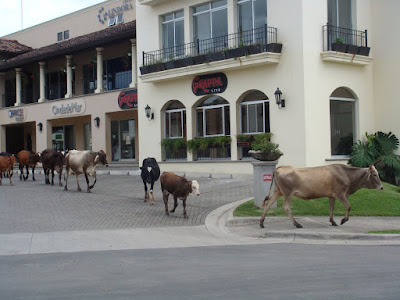
As we were finishing our lunch, Erin—who faced the window looking out onto the parking area and Via Lindora—exclaimed animatedly, “A loose cow!”
I spun around and didn’t see anything, and as I returned to face Erin she again urged us to look. I did, and there it was. I couldn’t believe my eyes as I saw the skinny, Brahma cow making its way alone down this busy commercial road.
Now it’s not unusual for us to see dogs, chickens, horses, cows, and oxen around here, sometimes even on the streets. I see them quite often on the mountain road to the girls’ school, and a few months ago my friend and I saw a cow grazing at the bank on a very busy corner in Escazú. But to see this cow hurrying down Lindora was definitely not the norm and caught everyone’s attention. “Se escapó” (he escaped), noted our waitress, grinning, as all of us in the restaurant laughed at the poor cow.
The restaurant is in Centro Comercial Momentum, an upscale shopping center that sits just off Via Lindora, by far one of the most congested streets in Santa Ana. Traffic on this road is always heavy and seemingly getting worse by the day.
As we were finishing our lunch, Erin—who faced the window looking out onto the parking area and Via Lindora—exclaimed animatedly, “A loose cow!”
I spun around and didn’t see anything, and as I returned to face Erin she again urged us to look. I did, and there it was. I couldn’t believe my eyes as I saw the skinny, Brahma cow making its way alone down this busy commercial road.
Now it’s not unusual for us to see dogs, chickens, horses, cows, and oxen around here, sometimes even on the streets. I see them quite often on the mountain road to the girls’ school, and a few months ago my friend and I saw a cow grazing at the bank on a very busy corner in Escazú. But to see this cow hurrying down Lindora was definitely not the norm and caught everyone’s attention. “Se escapó” (he escaped), noted our waitress, grinning, as all of us in the restaurant laughed at the poor cow.
And yet, not a minute later, came a couple more cows, soon followed by more cows—some of them literally running down the side of this road, cars and trucks passing them on the left. There was no farmer in sight.
Dan ran out to take a picture and then, after our bill was paid, we ventured around the corner to find the cows wandering into a lot across the street. They gathered there briefly, as if they were discussing where to go next, and then the leader headed off down a gravel road and the others followed. There were 14 cows in all.
I’m so glad I had my little camera in my bag so we could capture this moment. These are the unusual yet somehow typically Costa Rican-type things that make daily living here so memorable.

Monday, August 25, 2008
Fud for thought
My all-time favorite Far Side cartoon is the one in which a dog is trying to lure a cat into a clothes dryer by enticing him with paw-lettered signs and arrows leading to "cat fud." The desperate dog is silently pleading for the cat to fall prey to his wily plan.

I've loved this particular cartoon for years. Whenever I see a commercial for cat food I am really thinking "cat fud" instead. It's just funny.
Now you can imagine that I have to suppress a laugh whenever I walk past the cold cuts at the supermarket and see this brand of turkey breast:

In addition to the laugh I get when I read the Fud labels, I have this mental image of the Far Side dog sitting behind the CEO desk of his own Fud company, concocting new ways to unleash evil on unsuspecting cats everywhere.
Incidentally, Fud also makes flaming pink snack sausages that look completely unappetizing to me. Maybe the Far Side dog likes them. Ack!
Sunday, August 24, 2008
A change in calling Costa Rica
When we first moved here we had a seven-digit phone number. We learned that all phone numbers beginning with three, eight, or nine were cell phone numbers; anything else was a landline.
A few months ago, ICE (the government-owned phone company that has yet to install a landline in our house) announced that there was an insufficient number of phone lines to accommodate the country’s population of about 4.5 million people, and that instead of adding additional area codes (there is only one serving the nation), all phone numbers would go to eight digits. Rumor has it that this change will increase Costa Rica’s phone number capacity to 20 million phone lines, so the change oughta last a while.
To call a cell phone, one must now dial an eight first; all landline numbers are preceded by a two.
I had to edit all the numbers stored in my cell phone, which really wasn't that big of a deal, especially compared what those with commercial numbers likely had to change. I’ve seen instances where companies have squeezed in that eighth number on business cards, stationery, billboards, and signs. It’s kinda funny seeing it painted, penciled, and pasted in front of the other seven numbers.
The conversion seemed rather smooth. Now if I could just get my landline, I’d be happy to share my new eight-digit number with everyone!
A few months ago, ICE (the government-owned phone company that has yet to install a landline in our house) announced that there was an insufficient number of phone lines to accommodate the country’s population of about 4.5 million people, and that instead of adding additional area codes (there is only one serving the nation), all phone numbers would go to eight digits. Rumor has it that this change will increase Costa Rica’s phone number capacity to 20 million phone lines, so the change oughta last a while.
To call a cell phone, one must now dial an eight first; all landline numbers are preceded by a two.
I had to edit all the numbers stored in my cell phone, which really wasn't that big of a deal, especially compared what those with commercial numbers likely had to change. I’ve seen instances where companies have squeezed in that eighth number on business cards, stationery, billboards, and signs. It’s kinda funny seeing it painted, penciled, and pasted in front of the other seven numbers.
The conversion seemed rather smooth. Now if I could just get my landline, I’d be happy to share my new eight-digit number with everyone!
Tuesday, August 19, 2008
Only 132 shopping days until Christmas
Last September I mentioned how we saw Christmas candy on store shelves—and how this surprised us, seeing as it was only, well, September.
I would be remiss if I neglected to mention that our family went to Pricesmart last Saturday, August 16, and couldn't believe our eyes when we saw prominent displays of holiday decorations. Christmas trees in mid-August (and who knows how long they've been up)! I smiled and rolled my eyes as I passed the trees and continued down an aisle, but Erin followed me laughing so hard she had tears in her eyes, and Dan was amused too. Rumor has it that as they walked by these tall trees adorned with sparkling lights and gaudy ornaments, a young boy happily passed them singing Jingle Bells.
Pass the egg nog!
I would be remiss if I neglected to mention that our family went to Pricesmart last Saturday, August 16, and couldn't believe our eyes when we saw prominent displays of holiday decorations. Christmas trees in mid-August (and who knows how long they've been up)! I smiled and rolled my eyes as I passed the trees and continued down an aisle, but Erin followed me laughing so hard she had tears in her eyes, and Dan was amused too. Rumor has it that as they walked by these tall trees adorned with sparkling lights and gaudy ornaments, a young boy happily passed them singing Jingle Bells.
Pass the egg nog!
Sunday, August 17, 2008
Our first year
Today marks a milestone for our family: it was a year ago that we left Ohio for more tropical spaces. It's almost hard to believe an entire year has passed since that day.
To celebrate, we went to Pane e Vino—a favorite Italian place and the first restaurant we ate at as a family here in Costa Rica. As we devoured our pizza, we reminisced about our first day here: how excited, nervous, happy, exhausted, and hungry we were in those first hours. (And perhaps even just a bit overwhelmed with it all!)
Dan and I have also been talking about how much pressure we feel to keep traveling now that our time here is getting shorter. We've already done and seen so much—much more than appears in my blog—but there is plenty left that we want to do and see. We have learned a lot about ourselves and the world during these first twelve months. I look forward to seeing what the coming year has in store for our family.
To celebrate, we went to Pane e Vino—a favorite Italian place and the first restaurant we ate at as a family here in Costa Rica. As we devoured our pizza, we reminisced about our first day here: how excited, nervous, happy, exhausted, and hungry we were in those first hours. (And perhaps even just a bit overwhelmed with it all!)
Dan and I have also been talking about how much pressure we feel to keep traveling now that our time here is getting shorter. We've already done and seen so much—much more than appears in my blog—but there is plenty left that we want to do and see. We have learned a lot about ourselves and the world during these first twelve months. I look forward to seeing what the coming year has in store for our family.
Monday, August 11, 2008
I want my NBC
One of my favorite slang terms in Spanish is "estamos fritos," which means—literally—we're fried. The translated saying means we're out of luck. We're hosed.
So here we are in Costa Rica, greatly anticipating two weeks of glorious Olympics watching. Swimming! Gymnastics! Track and field! But when we turned on the TV to begin days of sports viewing we got a polite little note from our Costa Rican cable company that our NBC feed out of Denver was being blacked out. For two weeks. No games. ¡Estamos fritos!
I know you're wondering about Costa Rican TV. I mean, we can watch in Spanish, right?
You'll have to take my word for it when I tell you that Olympic coverage in this country is spotty and at times nearly non-existent. It is enough to make a girl cry.
Dan immediately began scrambling around with the computer, desperate to find some way for us to get video. Through a convoluted series of riggings made more difficult by our being in Costa Rica, he has finagled a connection from his laptop to our projector TV, and at night we are watching bits and pieces of the games on the wall in our office. I've been lying on the floor atop a sleeping bag and pillows, and Dan sits on the office chair to watch. Sometimes the girls come in with beanbags or pillows and join us.
We can't watch any video until NBC posts it (and of course that is delayed until the footage has aired on the network), and even then it's not the best quality and certainly not even close to HD. It's really sad.
Many of you know we’re huge swimming fans, and it's hard for us to wait until tonight to watch the men's 4x100 relay, which looks to be one of the greatest moments in US Olympic history. NBC is pulling its broadcasts off youtube, so this morning Dan and I—in sheer desperation after hearing about the mind-blowing anchor swim by Lezak—watched a video on youtube of the relay from a television station in Brazil. We can understand just enough Portuguese to get the idea of what the announcers are saying—and they were actually very animated—and in between Portuguese we kept hearing "Michael Phelps!" I got my first goose bumps of the games watching Lezak’s thrilling comeback. Now I'm aching to see it in English and am hoping for post-relay interviews and (dare I wish it?!) a medal ceremony.
I miss Bob Costas and his end-of-the-day synopses. I miss the tear-jerking and sometimes cheesy stories about athletes who have experienced the hard knocks of life. I miss the segments about China and how it prepared for the games, the Olympic theme, the medal ceremonies, hearing my national anthem, the interviews with athletes. I might even miss the commercials. I want my Olympics!
We waited four years for this? Estamos fritos, indeed.
So here we are in Costa Rica, greatly anticipating two weeks of glorious Olympics watching. Swimming! Gymnastics! Track and field! But when we turned on the TV to begin days of sports viewing we got a polite little note from our Costa Rican cable company that our NBC feed out of Denver was being blacked out. For two weeks. No games. ¡Estamos fritos!
I know you're wondering about Costa Rican TV. I mean, we can watch in Spanish, right?
You'll have to take my word for it when I tell you that Olympic coverage in this country is spotty and at times nearly non-existent. It is enough to make a girl cry.
Dan immediately began scrambling around with the computer, desperate to find some way for us to get video. Through a convoluted series of riggings made more difficult by our being in Costa Rica, he has finagled a connection from his laptop to our projector TV, and at night we are watching bits and pieces of the games on the wall in our office. I've been lying on the floor atop a sleeping bag and pillows, and Dan sits on the office chair to watch. Sometimes the girls come in with beanbags or pillows and join us.
We can't watch any video until NBC posts it (and of course that is delayed until the footage has aired on the network), and even then it's not the best quality and certainly not even close to HD. It's really sad.
Many of you know we’re huge swimming fans, and it's hard for us to wait until tonight to watch the men's 4x100 relay, which looks to be one of the greatest moments in US Olympic history. NBC is pulling its broadcasts off youtube, so this morning Dan and I—in sheer desperation after hearing about the mind-blowing anchor swim by Lezak—watched a video on youtube of the relay from a television station in Brazil. We can understand just enough Portuguese to get the idea of what the announcers are saying—and they were actually very animated—and in between Portuguese we kept hearing "Michael Phelps!" I got my first goose bumps of the games watching Lezak’s thrilling comeback. Now I'm aching to see it in English and am hoping for post-relay interviews and (dare I wish it?!) a medal ceremony.
I miss Bob Costas and his end-of-the-day synopses. I miss the tear-jerking and sometimes cheesy stories about athletes who have experienced the hard knocks of life. I miss the segments about China and how it prepared for the games, the Olympic theme, the medal ceremonies, hearing my national anthem, the interviews with athletes. I might even miss the commercials. I want my Olympics!
We waited four years for this? Estamos fritos, indeed.
Subscribe to:
Posts (Atom)