Showing posts with label food. Show all posts

Thursday, September 24, 2009

Munching your morning coffee

If you're a coffee drinker in Costa Rica, you're in luck! From what I've been told (though I'd never know from personal experience), CR has some amazing coffee. We've seen it growing right on the mountainsides, and if Dan's coffee consumption is any indication, the joe is delicious.

Now, if you're an avid coffee drinker and a cereal lover ... well, I guess you've hit the jackpot if you're shopping at the local grocery store, all thanks to McCallum's Coffee Flakes. I have no idea if these corn flakes covered in java pack a wallop of caffeine, but at least they're low in sugar, and they're made right here in CR. Afficionados can choose from capuccino, mochaccino, and vanilla—all for about four bucks a box.

¡Pura café!


Thursday, January 22, 2009

Yes! We have no bananas

We have no bananas today ... or this week, even. Or limes, for that matter. What's up with that?

I've been to the store a couple of times to buy these two Costa Rican staples and was shocked to find them both out of stock. The banana shelf has apples on it and in the limes' place is some unknown-to-me yellowish fruit that doesn't look like it would be a good substitute for a lime.

Hey, CR without bananas and limes? It's like Florida without oranges, Washington without apples, Wisconsin without dairy. (Holy cow! Imagine that!)

I know there are zillions of bananas just miles away on the east coast, so why aren't they in my Auto Mercado? (For the record, I have a mild allergy to bananas and don't even eat them, but Dan and Lauren think they're terrific. Take a look at the picture and see how cheap they are here: 220 colones for a kilo of bananas. That's about 40 cents for 2.2 pounds of bananas. Or I can buy just one banana for 21 colones which is about 4 cents!)

Monday, November 03, 2008

Boats, Arrows, and Monkey Tails (Our Adventure with the BriBri)

To continue the story of our trip to the Caribbean … we left off having lunch with our Spanish friends the Muelas family. Álvaro explained he had a work-related meeting with someone from the government. The man told him about a trip we should take—and he would arrange it for us—to an indigenous BriBri village, located on a reserve in the heart of the remote and lush tropical forest in the Talamanca mountains. The more we learned about the adventure, the more we wanted to go and realized what a once-in-a-lifetime opportunity it was. So we booked another night at the hotel and joked with our friends about coming back in one piece from the trip.

That night we bought hats for Erin and me and called Álvaro’s contact with our shoe sizes so they could get the tall boots we’d need to wear on our journey.

This was the real deal—authentic in every way. Not a lick of English was spoken by the BriBri, no brochures or T-shirts were available at their village. It was just us in their environment and an incredible adventure! Whenever you’re ready, you can watch a slideshow of our day.

The BriBri
The BriBri Indians (pronounced "bree bree") are indigenous people in the Caribbean coastal areas and mountainous rainforest of northern Panama and southern Costa Rica. Through traditional, non-invasive methods of agriculture, hunting, fishing, and use of products from the rainforest, the Bribri maintain a respectful relationship with the natural environment that sustains them. They wear western clothing and speak Spanish in addition to their native BriBri—and we learned how important it is for them to preserve their rich cultural heritage for future generations.

Start of the journey
We got up early (I spotted a poison dart frog hopping around—cool!) and drove to the town of BriBri to pick up long socks for the girls and water to carry in our packs. BriBri is on the Sixaola River—the border between Costa Rica and Panama—and we were able to look across the river at Panama for much of the trip.

After driving for about an hour on non-paved roads (rough terrain!) and through three small rivers over the roads (thank goodness we had the Rav4!), we arrived in Bambú, the closest commercial town to the reserve. We parked at the pulpería (a small general store) next to the police post where we donned knee socks and boots. The girls started chasing chickens around the buildings as we met Heliodoro, the boatman from the Yorkín community who would take us to the BriBri village.

We piled onto handmade wooden benches in a motorized dugout. I noticed duct tape on the boat bottom where a little water was gurgling up and tried to keep my boot over it to minimize the occasional water bailing our boatman had to do.

We traveled through the remote, tropical jungle surrounded by the sounds of the Yorkín River, birds and animals. We saw beautiful blue morphos floating through the air and many birds including several kingfishers and stunning tanagers whose brilliant red feathers stood out against the verdant landscape.

We were going upstream and the river was shallow and rushing in places. While the experienced boat driver knew exactly where to take us, at times he and the boatman in the front had to use long poles to push against the river bottom to keep us from running aground. At one point they had to get out and push our dugout through the shallows.

One of the most exciting parts of the boat trip is that we went into Panama. Lush Costa Rican jungle towered up steep cliffs to our right, while tree branches hung over the water to Panama on our left, so close we could reach out and touch them. Our passports aren’t stamped, but we’ve all been in Panama now.

About an hour later we reached the village set on the hillside, seemingly in the middle of nowhere. Once our boat stopped moving we felt the sun on us; the day was quickly heating up, and I was so glad we all had hats.

We trekked up the hill to see the very modest, one-room schools and begin the 20-minute hike through rainforest and mud to the village’s central building—the Stibrawpa Lodge. During our walk we learned about the area’s trees, plants, and crops. At one point the guide broke off a stalk of palmito for us to taste. Hygiene aside, we passed it around and everyone tried a bite. We also saw cacao fruit and a tall plant with a curly top called “monkey’s tail.”

Snack time
We removed our muddy boots at the lodge and left them at the bottom of the stairs, wearing our socks in the building which was like a large, wood platform. Everyone sat at one of the two long tables for a much-needed drink of watery juice (just squeezed from the fruit in the village), lychee fruit, and homemade bread made of homegrown bananas with a small amount of flour just to keep it together.

I was excited when our guide split a cacao open for us to see. The inside was filled with seeds covered in white flesh. Everyone took a seed and sucked on it. It had an interesting flavor that was nothing like chocolate.

We walked around the corner from the sitting/eating area and saw the village kitchen where a chicken (likely one of the many that roam the area) was cooking over a wood fire—the way all foods are cooked at the lodge, since there is no electric or gas stove.

Over the river
We walked to a nearby river to find a rickety hanging bridge about 20 feet above the rock-filled water. I was reluctant to climb the stairs and cross, but this was my Survivor Costa Rica moment and I was determined not to miss a thing—so I did it. I let everyone go before me (Álvaro teased me by swinging the bridge and barely lived to tell about it) but my faithful husband stayed behind me and offered encouragement. I gripped the guide wires the entire time and later learned that Dan was taking pictures and never touched the sides. What a guy.

On the other side of the bridge our guide showed us some towering, poisonous trees. He told us a few other things (all in Spanish, of course) but I was distracted watching the girls run around and telling them not to touch the trees. Then finally I asked if we were going swimming here (we had all worn swimsuits under our clothes and it was hot!) and was told no, we’d cross back to the other side. The bridge again? Already? I really just wanted to get in the water—but not by falling into it!

Cooling off
This river was clear, full of huge stones, and cold—but wow did it feel good! A refreshing swim was exactly what we needed. After about 20 minutes we climbed out of the river (quite literally) and brushed the dirt from our feet as best we could before putting our socks and boots back on.

Slings and arrows
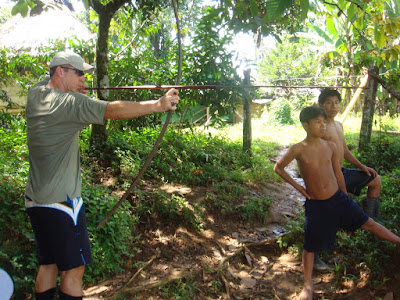
On the river bank we met some BriBri boys who wanted to teach us how they shoot their handmade bows and arrows. These handsome kids had such beautiful smiles and manners, it was a pleasure to watch them shoot the target (hanging fruit) and then let us take turns.

Dan’s dad was a national champ archer and taught Dan to shoot when he was little, so I wasn’t surprised when Dan’s rudimentary arrows grazed the target several times. The girls took aim too, and I was proud of them for trying—Erin said it was very hard.
Tasting monkey tails
By this point our stomachs were growling, so we returned to the lodge for a typical, delicious Bribri meal. We had the chicken we saw cooking earlier, fresh palmito, rice and beans, plantain and banana, and fried monkey tail (remember the plant we’d seen earlier on the trail?). Large banana leaves lined the serving bowls and covered our plates which were actually smooth, thick slabs of wood. Nobody was shy about taking seconds and even thirds, we were so hungry and the meal tasted great.

A lesson about the Bribri
Daisy, a BriBri Indian, taught us more about her village. Years ago, the Yorkín women united to form the indigenous association Stibrawpa, intended to diversify their means of production, particularly agriculture, and develop new sources of income while preserving their culture. It’s interesting that while the men are involved in decision-making for the Bribri, the women lead the village council and have directive control.

Now several Bribri families in the association grow a variety of crops as sustainable agriculture and also sell organic bananas and cacao, and the women create indigenous handicrafts for additional income.

Daisy explained to us that they have no medical care, but a doctor comes by every couple of weeks. Additionally, while the government has offered to bring electricity to them, they don’t want it; the concern is that it will drastically change their way of life for the worse and lure their children away from the culture they’re working so hard to preserve (an effort that includes Bribri language courses for the kids). They do have a couple of cold-water showers and two toilets near the lodge, but make no mistake that these people live very simply and rustically.

The Bribri live in small houses with roofs made of traditional palm thatch from primary rainforest. They sleep in hammocks or on the floor, with everyone in the same room. Some houses are isolated and the children have to walk a long way—even an hour or two—to school.

What most struck me was that these are happy, peaceful people. They work very hard for their survival but seem cheerful and content with their lives. They care for their environment, their families, and showed a genuine kindness to us. Despite the seemingly insurmountable differences in language, upbringing, and culture, I felt a connection to these women and great admiration for them. It was yet another lesson I’ve learned in Costa Rica about perspective in life.

Making chocolate
On to the most anticipated part of the day … making chocolate from the cacao, which is sacred to the BriBri. We learned how cacao seeds are dried and then toasted. The warm seeds tasted like bitter chocolate. A young man brought out a smooth, heavy stone and showed us how to crush the seeds with it. It’s a lot harder than it looks! And wow, the seeds smelled really good when we crushed them.

Once everything was in tiny pieces, he rapidly shook the bowl to separate the meat from the shells. Then he put the cacao into a hand grinder and everyone took a turn with the handle. What came out and into the bowl looked like thick, melting chocolate. A few of us couldn’t wait and dipped our fingers in for a taste. It was bitter but absolutely chocolate.

We took the chocolate inside the lodge where some of it was mixed with hot water and sugar to drink—a traditional BriBri-style hot chocolate—while the rest was combined with a can of sweetened condensed milk. Oh my gosh, please, this was absolutely some of the most amazing chocolate ever. Thankfully we are all good friends because most of us (especially Isa, Erin, and I) were dipping our fingers into the sweet chocolate, licking them off (all while animatedly discussing the deliciousness of it all) and then diving back in. True dark chocolate is considered to be about 50 percent cacao; we were eating 100 percent cacao (less when mixed with the milk). This was the freshest chocolate ever and wow, sooooooo good!!

The return trip
Late afternoon, we headed back to our boat and to Bambú. The river’s current was with us as we traveled downstream in the dugout, so the trip was considerably quicker than our first journey yet equally as beautiful.

It felt great to take off our rubber boots and long socks when we got to our cars. We said our goodbyes and headed back to Punta Uva with plans … everyone needed a shower (wow, were we dirty—especially Lauren!) and a rest, and then we’d meet up for our 7pm reservations at La Pecora Nera. Yep, again—because after our day—we made it!—we decided to enjoy the luxury of a fantastic, candlelit Italian dinner at a beautiful restaurant with our wonderful friends. We are truly blessed to have met the Muelases and spent this unique experience with them. It was a day none of us will ever forget and one that left a lasting impact on our lives.

Sunday, October 26, 2008

Caribbean calling

By the time we hit mid-October in the rainy season, we are all desperate for sunny skies and warm, dry breezes. The girls had off a few days from school at CDS, so we fled the waterlogged valley for the beautiful Caribbean.

It’s hard to decide what to blog about this trip—there were so many small moments we’ll always remember, yet journaling them all would fill pages. With that in mind, here are some highlights of our time on the coast and a photo album (best viewed as a slideshow) of the first few days of our trip ...

We set out on a sopping wet Thursday morning. About 20 kilometers north of San Jose, we drove through the mountainous Braulio Carillo National Park, an area beyond lush—it’s a gorgeous tropical rainforest with rushing waterfalls, flowers, and towering trees.

Once we came down from the mountains, we bid a big ADIOS to the rain! The rest of the trip was relatively flat, taking us over numerous rivers and past bunches of banana plantations, where the fruit hung in blue bags from tree after tree. The scenery wasn’t like anything we’d seen yet in Costa Rica, but then again, the Caribbean is different from the rest of the country in many ways.

Though just a few hours from the central valley, the Caribbean seems worlds away. The coast is still relatively undeveloped and, because it was so remote for so long, has its own unique culture. There are reserves of indigenous peoples here, and many of the area’s inhabitants are descendants of Jamaican immigrants who came to work on the railroads and banana plantations. These immigrants shaped the culture, and the area has a Jamaican flavor in its music (plenty of reggae), food (much spicier and less-Tico), language (some speak an English-based patois which I find harder to understand than Spanish), drug culture (yes, we smelled marijuana while walking down a beachfront street in Puerto Viejo), and even style of dress (plenty of dreadlock-sporting Rastafarians here).

Eventually we passed the port city of Limón. This is where the container ships come in and where our household goods first landed in Costa Rica. Limón is the largest town on the country’s east coast—a rough-looking place that ships millions of pounds of bananas to the world each year. It’s not much of a tourist destination, and we drove along the city’s edge to the south, along the coast.

We passed by Cahuita and drove into Puerto Viejo, then another eight kilometers to Punta Uva. It’s an understatement to say the drive is bumpy and jarring from Puerto Viejo to the south. The roads here are “paved” in tiny sections—most of the road is dusty and full of rocks and massive potholes. This is hands-down the worst stretch of driving we’ve ever done in Costa Rica. Our trusty RAV4 took quite a beating on this trip.

Finally, we reached our hotel (a compound of single-story buildings with four rooms apiece) and headed right to the beach where we spent much of our time during the next few days. This is said to be one of the best beaches on the Caribbean side of Costa Rica and was refreshing and clear. There was plenty of coral and fish for snorkeling, and—perhaps most fun for everyone—we got to play with a lot of CDS families we know who were also escaping the valley for drier climes and beautiful beaches.

Our first night we had dinner with our friends the Irlenborns at Maxi’s in Manzanillo. Maxi’s is a popular hang-out about five kilometers south of Punta Uva, and the drive is on a two-lane road lined with dense jungle. The restaurant sits at the dead-end of a tiny town and the last settled area in Costa Rica before entering a wildlife reserve that encompasses a few kilometers between Manzanillo and Panama. We had good food and lots of fun with our friends in addition to spotting a bunch of geckos on the ceiling and a few cats prowling around, too. (We noticed there were a lot of cats in this part of the country, actually, which I loved since I still miss my buddy Charlie.)

Sleeping was comfortable since we stayed in one of the few places on the beach with air conditioning. (No mosquito nets for us!) I still woke up each night though to the sounds of howler monkeys traveling through the jungle. I’ve mentioned these vocal animals before, but it bears mentioning that the calls of a troop can carry for miles and are loud enough to wake me out of a sound sleep.

We had breakfast at the hotel’s open-air restaurant each day. One morning while eating her eggs, Erin spotted a sloth across the path near our room. Sloths rarely come down from their treetop homes, so this was a great surprise. We walked over to watch the three-toed creature s-l-o-w-l-y pull itself with its hands over the land and up the giant tree right outside our room. It was a fortunate opportunity to see this.

A few times on this vacation we drove into Puerto Viejo, which is truly Caribbean—steamy, sandy, and laid-back. It’s really hot in this surfers' hang-out, and people take life more slowly here. Between Punta Uva and Puerto Viejo we saw a lot of people walking and riding bicycles, nobody in much of a hurry to get anywhere.

On Friday at the beach, we met up with our friends the Muelas family from Spain. We snorkeled and swam with them, and that evening the eight of us had reservations at a fabulous restaurant in Cochles called La Pecora Nera—a mouthwatering taste of Italy on the edge of the Costa Rican jungle. Many travel guides and travelers agree that this beautiful, open-air restaurant has the best Italian food in the country. The owner is this exuberant, young Italian guy who was not only our chef but also part-time waiter who advised us—with a flourish—on what to order that night. It was a long, leisurely, and fantastic dining experience with a family whose company we truly enjoy.

The following morning we walked along the hotel path that leads to the main road. Surrounded by jungle, we saw blue morphos (love them!), turtles, crabs, and birds. The foliage here is so thick and wild, Dan commented that a person wouldn’t need to walk far into it before he or she might never come out.

Of course we parked ourselves at the beach after the walk for hours of swimming and relaxing in beach chairs under the palm trees (ah, heavenly!). We went to lunch with our Spanish friends that afternoon and, while there, decided to extend our vacation to do something unique, adventurous, and amazing. That story is to come in the next blog entry and will tell of one of our most memorable days here in Costa Rica!

Monday, August 25, 2008

Fud for thought

My all-time favorite Far Side cartoon is the one in which a dog is trying to lure a cat into a clothes dryer by enticing him with paw-lettered signs and arrows leading to "cat fud." The desperate dog is silently pleading for the cat to fall prey to his wily plan.


I've loved this particular cartoon for years. Whenever I see a commercial for cat food I am really thinking "cat fud" instead. It's just funny.

Now you can imagine that I have to suppress a laugh whenever I walk past the cold cuts at the supermarket and see this brand of turkey breast:


In Spanish, "fud" is pronounced—yes, you've guessed it—"food." It seems like a large-scale typo right there for everyone to see. It's as though someone thought "food" would be a good name for lunchmeat and then spelled it wrong, and nobody called him or her on it.

In addition to the laugh I get when I read the Fud labels, I have this mental image of the Far Side dog sitting behind the CEO desk of his own Fud company, concocting new ways to unleash evil on unsuspecting cats everywhere.

Incidentally, Fud also makes flaming pink snack sausages that look completely unappetizing to me. Maybe the Far Side dog likes them. Ack!

Thursday, July 03, 2008

A berry good day

My dad has a reputation in our family for his sweet tooth, and no dessert makes him happier than my mom's homemade shortcake smothered in juicy strawberies fresh from a local farm here in Wisconsin. We all love it, truth be told, so this morning Mom, the girls and I went to pick some berries in anticipation of having shortcake after dinner.

The girls had never picked strawberries, so this was a new and fun experience for them. We went to Jolivette Family Farms, best known in the area for berries, sweet corn, and its pumpkin patch. The weather was gorgeous—sunny and 70 degrees with low humidity—which was perfect for being in the field.

I'm not sure how long we picked, but Mom and I appreciated the girls' help; I think it's a lot easier to pick for kids who are naturally closer to the ground! They really enjoyed finding the biggest berries and those that had grown into "triple berries." A nice lady a few rows over even found a "quintuple strawberry" whose five berry sections looked like flower petals, and she gave it to Erin and Lauren.

Once we'd each filled our flats about halfway we decided to head in. I think the girls would have picked longer, but they didn't have to clean all the berries! We rode back to the roadside stand on a big wagon behind a tractor. Then the girls helped Mom and I get our berries on the belt to be weighed; I don't know how many pounds we picked, but I do know that it took us a long time to clean them, and my nails are still a bit stained with berry juice.

We made shortcake after supper tonight and oh, was it good! There are lots of berries left (bunches of them in the freezer) and we'll have shortcake again tomorrow, too. Dad's not the only one happy about dessert!

Friday, June 20, 2008

P is for chicken

Yesterday was a good day and a busy day: laundry, gym, going to the pool which doubled as a study session (my neighbor is learning Spanish and had a big test yesterday so I quizzed her), lunch at our friends' house, etc.

Lauren and I got home at 2:00, and around 3:00—sometime between washing beach towels and checking email—I realized I hadn't put the chicken for dinner in the oven to roast. I ran to the kitchen, pulled the chicken from the fridge, and turned on the oven.

Not sure exactly how much time I needed to roast a 2 kilo chicken (hey, at least I didn't have to look up the conversion to pounds—just over 4, by the way—so hurray for me!), I whipped out my old Betty Crocker cookbook and quickly flipped to the index. To the P section. You know, where words start with the letter P.

I was in a hurry. I was scanning at top speed. P, p, p ... c'mon, where are the entries for chicken?! I wasn't looking up poultry here, I was looking for chicken. Chicken!

Because chicken starts with a P, you know. As in pollo. As in Spanish for chicken.

Some days, the languages just get all mixed up in my brain and I’ve gotta laugh.

¡Pura pollo!

Wednesday, June 18, 2008

The Rain Forest Café

Parents of CDS second graders need look no further than their child’s classroom for a unique, memorable, and really fun dining experience. The Rain Forest Café, a yearly tradition for seven- and eight-year-olds, is a favorite activity of CDS families and certainly not your typical school lunch. Lucky us that we have a second grader!

The kids prepared for the café for several weeks. Lauren’s classroom was decorated like a lush, tropical rain forest, complete with a waterfall, twisting vines and branches hanging from the ceiling, plenty of colorful animals and insects, and beautiful leaves and flowers. We even saw a few iridescent hummingbirds outside the window which often enjoy the bougainvillea on the fence bordering the school.

As part of the preparations, each student studied a particular rain forest animal and wrote a detailed report about it, including illustrations and interesting facts. Lauren chose the squirrel monkey—my very favorite creature here in Costa Rica and, I think, a suitable choice for Lauren.

After the kids had been working on this project for nearly a month, Dan and I received a lovely invitation printed on homemade paper to come to the school for a special brunch served at the café. And special it was!

When we arrived, the kids were dressed as little waiters and waitresses, decked out in green aprons embroidered with “rain forest café” (what great keepsakes). Our personal waitress (guess who!) gave us $10 in rain forest money, led us to a table in the corner, and offered us a beautiful, hand-drawn menu.

The menu of 19 items included a variety of beverages, breads and muffins, fruit, main dishes, and sweets, all at reasonable prices, of course. An example of the offerings:

Rain forest mud (coffee)
Margay spot muffins
Morpho bread (banana bread)
Flying mangoes
Red eye tree frog sushi
Ocelots’ dinner (rice with palmito)
Scarlet macaw sandwiches
Piranha brownies
Jaguar spots (cookies)

Dan and I placed our order with our sweet server and she scribbled everything down on her tablet. Before she left to total our order, we had a chance to ask her questions about squirrel monkeys—because the tag on her shirt said she is an expert! Did you know that the squirrel monkeys' tails are the longest of all the monkeys’ tails? Or that squirrel monkeys give birth during the rainy season? Our server did (and now we do too)!


Our food was truly a meal's worth (especially the howler monkey pizza). Of course we asked to see the manager (Lauren’s friend Isabel—the capuchin monkey expert—who just happened to be turning eight that day) to give her our compliments. We learned she was made manager because she had the highest score on the math test and was best at helping her classmates make change with the rain forest money.

We made sure to ask plenty of questions of the girls about the rain forest, including whether the girls had their monkey tails hidden in their pants because we’re certain that secretly they are monkeys themselves. That sufficiently embarrassed them, making Dan and me feel pretty good about our parenting skills.

At the end of our meal, we tipped (with real colones this time!) our server and the café manager, and they gleefully wandered off, giggling about their tip and our teasing.

Finally we left this special café, so tickled with it all. The best part is that all Lauren has learned about the rain forest is applicable to her life here—and she has experienced it for herself. This tiny Central American country is one of the most bio-diverse regions on the planet, a home for some 10,000 species of plants and trees. We have seen and heard the squirrel, capuchin, spider, and howler monkeys in their natural habitats. The three-toed and two-toed sloths are not strangers to us. Agoutis, coatis, bats, scarlet macaws, morpho butterflies, crocodiles, the rare silky anteater, and a plethora of lizards, birds, and bugs—we’ve seen these rain forest creatures (and more!) living in the wild. It’s an opportunity hard to match and a learning experience that extends far beyond the classroom. We are living an amazing adventure!

Monday, May 26, 2008

Gone to Kentucky and Indiana

Nah, we didn’t make a trip to the Midwest this past weekend, but we did the next best thing for two gringos living in Central America … we went to dinner and a movie, of course.

On Friday night, Dan and I stopped at the huge food court at the mall outside the movie theater for a quick meal. Usually we go for tacos, but for some reason both of us broke out into grins when I mentioned the KFC on the far side of the court. Ohhh, it was so good—the food tasted just like KFC at home! It was the first time we'd had KFC since arriving here, and we may have to stop back again.

Funny thing is, the Costa Ricans call KFC "Kentucky." Last summer our relocation counselor told us that she loves Kentucky, and it took us a minute to realize she meant the original-recipe, biscuit-making, potatoes-and-gravy Kentucky and not the bluegrass, basketball-loving state.

Here’s another for instance: A boy in Erin's class mentioned to the teacher that he went to Kentucky over the weekend, and the kids' teacher, an American, was skeptical.

"Well yeah, it's just food," the kid said, and then someone chimed in that Kentucky is a chicken restaurant. It looks just like the KFCs at home too, complete with the image of Colonel Sanders and the slogan, "para chuparse los dedos"—which is about as close to finger-lickin' good as things get here in Ticolandia.

After our dinner we walked to the theater; the new Indiana Jones movie premiered here on Friday night! We don’t go to the movies too often, but it’s always fun when we do—especially because regular tickets cost only four bucks, about half the price of a movie in the US last time I looked.

The movie was showing in several theaters, both dubbed and with subtitles. Sometimes we get a kick out of the subtitles (we can’t help but read them as we’re watching) and the translations. For example, in the Harry Potter movies, Voldemort is Señor Tenebroso (Lord Tenebrous, Dismal, Gloomy, etc.). I don’t know why they don’t just call him Voldemort. I mean, it’s his name—it’s not like Voldemort means anything in English, right?

Anyway, we enjoyed Indy, as silly as it was. Sometimes complete suspension of disbelief is a great escape after a long week—and two kids from the US enjoyed a virtual trip home for a few hours.

Wednesday, May 21, 2008

Beware the wily lime

Something interesting happens when a person lives nine degrees above the equator, forgets to wash her hands after juicing raw limes, and then ventures into the bright sunshine. She ends up with a horrific burn on her skin, leaving it raw, pink, and very tender.

I’m relieved to say this didn’t happen to me, but unfortunately it did happen to a friend of mine. The chemicals from the limes were activated by the strong sun, leaving her with a nasty looking case of phytophotodermatitis—a lime burn—that is still painful weeks later. Ouch!

I have a love affair with limes, and thankfully they are plentiful and cheap here, so I use them a lot. Now I’m extra careful about washing up after handling citrus fruit. I’m more interested in eating ceviche than becoming it!

Sunday, May 18, 2008

Ribs and cake (aka: basketball injuries, part two)

Yesterday, Dan joined a bunch of guys from the office to play basketball for a company program encouraging everyone to get active and be healthy. The games were held in Escazu at a local gym. It was fun to visit with friends and see the brightly painted floor, the refs in their blazing orange shirts, and the scorekeepers flipping papers with numbers on them for the score.

That was the good part. The bad part—other than Dan’s team getting walloped—was that basketball is just not a big sport around here, and most of the guys on the court didn’t seem to have much experience. This led to some amazingly wild passes soaring through the air and, unfortunately, a lot of elbows and bodies flying too. And not much refereeing!

I told Dan before we left for the gym that my goal was to avoid a trip to the ER at the hospital. We managed that, but halfway through the game I saw Dan sitting under the basket pleading with the ref for a call. I knew he was hurt when he got up and didn’t have his usual spunk—and sure enough, he injured a rib again (on the other side this time).

Erin felt sorry for her dad, so when we got home she baked him a cake from scratch in hopes that he’d feel better.

Thankfully this morning the rib is just sore and it’s not nearly so bad as last time, but I told Dan that his days of b-ball in the land of flying elbows are over.

Thursday, April 17, 2008

Colas, sodas, and what’s on the menu

Here’s a little tidbit about eating and drinking in Costa Rica, with a Spanish lesson thrown in for fun.

If you’re looking for a bubbly beverage here in ticolandia, don’t ask for a cola. In Costa Rica, a tail—whether on an animal or a ponytail in the hair—is called a cola (sounds just like the cola you drink).

Perhaps you could order a soda? Not here. A small restaurant that serves traditional, inexpensive Costa Rican food is called a soda (yep, sounds just like the soda you drink). These little sodas are all over the place, even in remote areas of the country where one wonders how the soda gets its supplies and who is eating there. Anything but fancy, sodas often are sometimes just simple support structures with tin roofs or tarps overhead, as you can see was the case at Soda El Mango where we had lunch on a Manuel Antonio beach.


Sodas serve comida típica—typical/traditional tico food—which relies on local agriculture and cultural tradition. These very modest eateries sometimes don’t even offer menus to diners since it’s known they serve native dishes.

Typical tico dishes such as gallo pinto (a mixture of rice and beans) and casados are the norm. Casado means married, and casado plates are marriages of food to make a meal: rice, beans, a salad of some kind (perhaps heart of palm or cabbage and carrots), fried plantains, and some kind of meat or poultry. My favorite soda food is chifrijo—a combination of chicarrones (fried pork), frijoles (beans), rice, pico de gallo and some other yummy stuff that tastes fantastic.

Eating at soda is a great way to immerse oneself into the tico culture while getting a filling meal at a fair price.

So what do you ask for if you’re thirsty? A carbonated beverage is most often called by its actual name: Coca (for Coca Cola), Coca Light, Fanta … you get the idea. There are oodles of fruit juices here. Coconut milk—sipped from a coconut through a straw—is sometimes sold along well-traveled roads. And of course coffee is king in Costa Rica.

Our favorite drinks are the refrescos—sweet, satisfying concoctions made of liquefied, fresh fruit blended with either water or milk. These traditional drinks are available in loads of flavors such as watermelon, mango, strawberry, blackberry, tamarind, passion fruit, guanabana, and cas. Our favorites are watermelon and strawberry.

If you’re brave enough to try something that really packs a punch, sip a bit of guaro, the national liquor of Costa Rica made from distilled sugar cane.To minimize production of bootlegged guaro, the tico government nationalized the manufacturing of the stuff with the Fabrica Nacional de Licores-Fanal, offering Cacique, the only legal brand of guaro, since the mid 1800s. Just don’t become a guaro vaquero (guaro cowboy)—someone who’s had too much too drink and acts like an obnoxious fool!

There are plenty of other drinks available here in Costa Rica, but perhaps the best news is that you can safely drink tap water here, which is not the case in many Latin American countries. It's freeing not having to worry about what's in the water and makes eating and drinking much simpler.

Cheers!

Monday, March 03, 2008

The shortage ends (and why expats love stuff from home)

Do you recall the dreadful mac and cheese shortage that recently swept Costa Rica? I’m pleased to share with you an update on the status of blue boxes here in the valley …

Our friends David and India called us after church yesterday with the news: there was one precious pallet of Kraft M&C in at PriceSmart. Yippee! They kindly bought 30 boxes for us (we just couldn't ask for more!), and we intend on a trip to the store soon in hopes of finding another couple dozen.

Shortly after we returned from a relaxing Sunday afternoon at the pool, David arrived with the blue boxes. Dan promptly rescued two of them from their shrink wrap and made dinner—and it was delicious.

In other food news, I recently purchased brown sugar for the first time since we've been here. I had been making do with azúcar con caramelo (sugar with caramel, basically) which was not bad, but my cookies and baked goods just didn't taste quite the same or have that perfect consistency. I didn't know if I'd ever find brown sugar here until a friend told me it is possible, but difficult, since it's rarely in stock. Yet there it was last week, unassumingly sitting on the shelves as if it had been there all along. I bought numerous boxes, but two are already gone. How long will brown sugar keep, anyway? Because I'm planning on getting a whole bunch more while the getting is good.

Think we're crazy? That we’ve completely lost our grip on reality since moving south of the border? This enlightening piece by expat Pamela Druckerman explains how valued American goods can be to those so far from home. Funny thing is, I hadn’t read this article since it was first published—right before Thanksgiving—and now I see that Kraft Macaroni and Cheese and brown sugar are both mentioned in the text. How validating!

It’s true that expats thrill at the thought of jamming suitcases full of products straight off the shelves of Target and Wal-Mart and lugging the stuff back to their adopted countries. Those people visiting expats are lovingly (yet eagerly!) considered as pack mules. My parents will be here soon and have a list of goodies to haul—from two Nintendo DS games for an American friend of ours to sugar-free Tums, peanut M&Ms, Gain apple mango tango dryer sheets, and packets of Taco John’s hot sauce if they can get them (oh please, we're begging!). We are more than excited to see Mom and Dad, but I’m sure soon after they’ve settled in we’ll be asking, “Where’s the stuff?! Did you bring the Reese's Pieces???”

Saturday, February 16, 2008

The blue box blues

When mama wants to please me
she's only got to cheese me!
I got the blues ...


A minor crisis has struck our household in the form of what appears to be a country-wide shortage of Kraft Macaroni and Cheese. Yes, the marginally nutritional, unnaturally orange, yet unfailingly comforting and homey pasta dinner in the blue box. Can't find it anywhere—not even at the big warehouse club down the highway. I open the kitchen cupboard and see that empty spot where the mac and cheese normally resides, and feel a pang of despair. In a country with extremely little in the way of frozen or pre-prepared food, we've come to rely on Kraft mac and cheese for an easy Sunday supper or a snack to fill hungry bellies.

Here's the thing: One can never count on anything imported from the US to be in stock. A month ago I needed a basic antibiotic and was told at the pharmacy that it was unavailable and I wouldn’t find it in any pharmacy in Costa Rica. I asked for a substitute and got one, no problem. (A side note: you don’t need a prescription for many drugs in CR, including antibiotics.)

Another example … When we first moved here, I bought a couple of cans of Campbell's tomato soup, because it's my favorite and Lauren loves it, too. It costs twice as much as at home, but it was a splurge we were willing to make.

Next trip back to the store ... no Campbell's tomato. Cream of mushroom, chicken noodle, a stray can of Manhattan clam chowder, sure. But no tomato.

We tried other kinds of tomato soup, but nothing fit the bill. I was disappointed until—several months later—there they were! Four cans of tomato soup wrapped in familiar red and white labels. Not to be fooled again, I bought all four cans. This last week there was an impressive stock of the stuff. Why? I have no idea. Sometimes stores carry a lot of a certain import and then it will disappear off the shelves for weeks to months at a time.

Sadly, the mac and cheese has vanished. We buy it in bulk at Pricesmart, and all four of us stood dumbfounded and stared at the shelves last Saturday when we realized there was no mac and cheese. What's the deal? Are the Americans hording all the mac and cheese, creating increased demand for the stuff and causing this shortage here in Central America? (And if so—hey, knock it off!)

We'll play the waiting game, and at some point I expect we'll stock our makeshift food storage room with a case or so of Kraft Mac and Cheese. Until then ... we've got the blue box blues.

Monday, November 19, 2007

Put a little jelly on the Bimbo


Our most-purchased brand of bread in Costa Rica? Bimbo. All you non-Spanish speakers say it with me: BEEM-bo.

Yep, it’s the most popular sandwich bread around. We see Bimbo ads scrawled across trucks, billboards, even clothing. Erin loves it; she wants a shirt that says Bimbo.

I told her she could get one only if she promises never to wear it in the United States. Girl's gotta keep her reputation, you know.

Saturday, November 10, 2007

A heaping plate of what?

Friday was filled with anticipation for Lauren and her friend Isabel. Thoughout the day the two whispered excitedly about their after-school play date at Isabel’s house.

When we picked Lauren up at 6:30, she told us about her afternoon. She and her friend ran to the playground, made up a game involving a giant boulder and a soccer ball, and dressed up like princesses. Lauren happily relayed that she and her adorable Spanish friend have a lot in common (even their favorite color—yellow) and are the best of friends…but for one thing. Isabel’s family was going to have octopus for supper. “And Isabel LIKES octopus!” said my daughter in disbelief.

Lauren swears she saw Isabel’s mom chop the head off the octopus and that she counted all eight tentacles. “There were like a hundred suction cups!”

A cheer went up from the back seat when I told my little girl our family was having lasagna—not octopus—for dinner. She was saved; we'd picked her up just in the nick of time.

Monday, October 22, 2007

Ribs and bananas

Sadly, I'm not talking about tasty ribs hot off the grill and dripping in sauce; the title refers to Dan's ribs, at least one of which is likely broken.

Dan has been playing basketball at the girls' school on Monday nights with a friend and some other guys. A week ago, he took an elbow shot to the side and had a hard time catching his breath for a few minutes. Now he's got a busted rib, is done with basketball, and hasn't been able to run for a week. Apparently ribs are slow to heal. Good thing we have an ample supply of ibuprofen in the house.

On a lighter note, thought I'd share a rather ordinary experience I had this morning that made me laugh.

I was driving down the highway at about 7:30, following a rickety little truck with a mountain of pineapples in the back and large bunches of bananas hanging off the sides. The truck was very slow-moving, so I changed to the left lane to get by. The funny thing was, as I passed the truck, the driver was grooving out to something on the radio and eating a banana. One less to sell, I guess, but at least we know he endorses his product.

Talk about a job with appeal! (That one was for you, Dad!)

Wednesday, October 17, 2007

Mama Mia Pizzeria

Our family loves pizza, but we've found that pizza delivery can easily cost 30 to 40 dollars—too much to spend too often. So six weeks ago, I decided I'd make my homemade pizza regularly and for just a few dollars for two pizzas. And with that, a young tradition of Pizza Night was born.

Tuesdays are busy here. Between work (Dan), drama class (Erin), and soccer (Lauren), our family doesn't get home until 5:30. Since pizza is quick to make once the dough rises,Tuesday night became Pizza Night.

I've always enjoyed making pizza dough, but I had a small challenge—I had to figure out how much yeast, in teaspoons, was in a packet of yeast that I'd find in the US. Here, yeast is sold in small containers with lids and is actually quite cheap. I have to admit, I screwed up the calculation the first time I proofed my yeast and ended up with yeast bubbling over the small bowl. It was pretty funny. (I should have taken a picture of that!) I recalculated and found my mistake; now my pizza dough turns out just right every time.

We've even experimented to see which brand of mozzarella we like best. Everyone admits that Tuesdays are fun now, and Pizza Night has become one of their favorite nights of the week.

¡Buen provecho!