Sunday, March 29, 2009

Here’s to being healthy

My apologies for not blogging much these days. Not only have things been busy with school (thank goodness the science fairs are done!) but we’ve been battling one illness or infirmity after another. Lauren and Dan both had colds, then me, now Erin too. I am still recovering after three long weeks of battling a bacterial lung infection which has sent me to the hospital twice for breathing treatments and has caused me to lose my senses of smell and taste for more than two weeks, which is depressing, I gotta admit. (I told Dan that I want to go out to dinner as soon as I feel better and can taste my meal.) Of course the dirt and dust swirling around in the air aren't helping things.

Last month I went through a bunch of physical therapy for a messed up shoulder. The PT here is terrific, but WHEW! I am so ready to feel healthy and normal again!

Anyway, I thought this would be a great opportunity to share a little about healthcare here in CR, which is markedly different from that in the US.

The Caja Costarricense de Seguro Social (CCSS) is CR’s nationalized healthcare system. Known as the Caja, the system provides inexpensive health services to the Costa Ricans. While the Caja offers low-cost alternatives, wait times are often long for routine exams to vital surgeries. I’ve heard the red tape can be a nightmare as well, but in the end the healthcare is said to be cheap but high-quality.

We don’t participate in the Caja (though we could if we chose to) but instead have international insurance through CIGNA. We visit doctors at CIMA, the beautiful, nine-year-old private hospital about 15 minutes down the highway in Escazú. Here we can still get high-quality medical care for much less than we would in the United States. Many of the doctors here trained in the US, Canada or Europe, and most speak some English. (Yesterday I took Erin to CIMA for a sore throat and was speaking solely in Spanish with the doctor. She asked me if it hurt Erin to swallow and I couldn’t remember the word for swallow in English, but the doctor knew and blurted it out. Ha!)


We use the hospital’s ER as an urgent care center, but we also have our own personal physicians. Going to the doctor here is much more pleasant than at home. There are waiting rooms for many doctor offices, but once you are in the door to the office, you’re really in. For example, my doctor has his desk right as I walk in the door. The room has half a wall and on the other side is the scale, the examining table, a bathroom, etc. and there is plenty of space. No nurse is there to take vitals—my doctor does it himself. I love this because it gives me time to talk with him, and I have not felt rushed during an appointment for myself or for the girls (who have their own pediatrician). The patient gets undivided attention because the doctor doesn’t have to hop from room to room and the patient is not stuck waiting and bored. I’m really going to miss this when we move back to the US.

Medical tourism is very popular in Costa Rica—people from North America and Europe flock here for everything from dental work to cosmetic surgeries and cancer treatments because of the low cost of care, personal attention, and beautiful surroundings.

Prescriptions in CR are called recetas—the same word for recipe in Spanish, which I always find amusing. Recetas are not needed to purchase many medications in Costa Rica (for example those for blood pressure, cholesterol, birth control, to name a few), though several months ago pharmacies did begin requiring prescriptions for antibiotics. One of my favorite things about the pharmacies here is that they deliver right to my door for no extra cost. One of my least favorite things is that you have to ask the pharmacist for just about any medication—even those that you could buy over-the-counter in the US.

I’ve been a frequent customer at the pharmacy lately with all these crazy colds and infections. While I’m really grateful to have CIMA nearby, here’s hoping everyone in our house is well soon and we can quit wearing our path to CIMA’s doors.

Tuesday, March 10, 2009

Dust in the wind

When the winds pick up in December and January, it’s cause for celebration: rainy season is on its way out and the sunny, beautiful dry season has arrived. (I blogged about this last year, mentioning how noisy and dusty life is during windy weather.)

Eventually the gusts subside and the valley is left with the gorgeous weather people dream about. Normally. This year, however, it's been much cloudier than last season and the wind isn’t letting up. It's been blowing like mad for weeks, making it hard to sleep some nights and frustrating on those bright, clear days when we want to play and swim outdoors but get blasted by blowing dirt and dust. I’d love to spend dinner out on our patio, enjoying the optimal temperatures and a beautiful sunset, but it would be futile. Too darn windy!

Not long ago a new billboard went up along the highway not far from my house—a big one on a fat, steel post. Enter the crazy winds, and after only a week the billboard had crashed. I got a few photos of it (evidence, you know) the morning after it happened.


Perhaps the most frustrating thing about this wind is that we can’t keep our windows wide open, which is something we normally love about living here. There is so much pollution in the air—dust, dirt, pollen, ash (lots of controlled and uncontrolled fires during dry season) and who knows what else blowing around—and it comes right into the house. I can dust the furniture, open the windows, and a couple of hours later run my hand over the table only to find brown dirt and grit on my palm. I’m serious about this—no taking literary license here. We can look out our back window and see stuff whirling in the air—and then I think about us breathing all that in. It’s disheartening.

The other day the DJ at a local radio station played Dust in the Wind by Kansas. I think he was having a poke at this crazy Costa Rican weather.

Monday, March 09, 2009

Bet you won't hear this at your grocery store today ...

MegaSuper is not my favorite supermarket in Costa Rica for many reasons, and I normally only stop there for the basics—milk, bread, and eggs. While I don't care much for the store, I do appreciate that the MegaSuper people play some entertaining music for shoppers, including plenty of stuff in English which I enjoy.

Yesterday was an exception to that rule. Erin and I were looking at hot dogs when we heard the first notes of a very popular song. An instrumental, nicely done, very pleasant but extremely out of place. Silent Night. Yeah, the Christmas song. In March! What's up with that, anyway?

Thursday, February 19, 2009

Quiero cambiar el idioma de mi Internet

So I live in Costa Rica, and the official language here is Spanish. I get that and I speak Spanish daily—not really a problem for the most part. That said, I have to admit that it really bugs me that a lot of Web sites I visit regularly—including this one—keep coming up in Spanish, even after I have repeatedly set the preferences for English.

Google, for instance. Dang, it is always coming up in Spanish! I’m forever landing on google.co.cr. Sure I can read it and understand it, but I want my Web in English. It’s like when I visit Delta.com to book flights to the US: if I don’t take the time to enter my SkyMiles account number, the prices for the flights come up in colones. ACK! Give me dollars, Delta, please. The less often I have to do math, the better.

It’s a minor problem in the grand scheme of life, but an annoyance that I thought was worth a mention (OK, gripe) about since I’ve run into this problem twice in the last hour.

Sunday, February 08, 2009

May I have this dance?

Each February the girls' school has a father-daughter dance—complete with party music and Valentine's Day-themed decorations, a professional photographer, and plenty of food and cake.

I had a great time helping with the event last year (plus, the only way for a mom to attend the dance is to be on the committee!) and was excited for the dance again this year. Erin even helped me burn a couple of CDs for the DJ so he'd have some of the popular music from the US that the kids like.


We bought the girls' dresses last summer in Minnesota and thankfully they still fit. After school—once the decorating was done—the girls and I did hair and nails and got all dressed up. (It took Dan about one-fourth the time to get ready as it did the three of us.) Dan even gained a daughter for the evening—Lauren's friend Isabel, whose dad was out of town for the night. I'm glad she could be there with us; we love her family and will miss them tremendously when we leave Costa Rica.

I tried to get a few snapshots to share in between serving sandwiches and clearing tables. We even managed to get a picture of the four of us. Enjoy!


This is Erin, Grace (the friend we saw on vacation in Orlando) and Erin—yes, we moved all the way to Costa Rica only to meet another Erin of the same age as our Erin. Who would have guessed?


Here are Lauren and Isabel, artists extraordinaire! There were four boards on the side of the dance floor where the girls could write the names of their favorite restaurants, movie stars, and vacation destinations. Once we let the net of balloons drop, Lauren and Isabel made a beeline to the boards with the Sharpie markers to decorate the balloons. They are always drawing, these two.

¡Pura baile!

Sunday, February 01, 2009

Fabulous Florida

"The whole object of travel is not to set foot on foreign land; it is at last to set foot on one’s own country as a foreign land." —G.K. Chesterton

Our big Christmas gift to our family this year was a trip to The Motherland…10 terrific days in Florida. Time spent in the United States. Yippee!

Here, in no particular order, are a few highlights of our vacation:

**Dan, running enthusiast that he is, took on the half-marathon at Disney World on a Saturday and followed it by running the full marathon on Sunday. That’s a whole lotta miles—39.3 to be exact! He brought home plenty of race bling, including the Goofy medal because those who run the half (Donald medal) and full (Mickey medal) are also known to take on the Goofy Challenge. I’m still not sure how he finished the races and still walked three Disney parks the next few days, but he did and I’m so proud of him!

**Shopping. Oh, wonderful US retail, how I love thee! Our credit card got a major workout just in our first 48 hours in the States. We didn’t even get from Miami to Orlando without dropping a bundle on new clothes for the girls, so desperately needed. We had plenty of fun at the outlet malls and Downtown Disney—but don’t be fooled! Shopping included much anticipated trips to Wal-Mart and Target. Even buying groceries to stock the condo was a high. We splurged on foods that we really miss living in CR.


**Speaking of food … it’s amazing how comforting favorites from home can be. We had delicious Tex-Mex, plenty of snacks, and a trip to Orlando would not be complete without dinner at Joe’s Crab Shack—a Beaudry family favorite.

**Yes, we love to swim and we go to the pool here often, but despite cooler temps in Orlando we were able to swim in beautiful heated pools. Fantastic!

**Driving! How luxurious are US interstates, I ask you! They are smooth, wide, well-marked and with drivers that, for the most part, obey the rules of the road. Not once did I see a bus stopped on the highway, cows heading down the street toward me, or a pothole so big I thought it might swallow me whole.

**Oh, did I mention Disney? We love visiting the parks. We went to Animal Kingdom for the first time and thought Expedition Everest was a most awesome coaster. The Nemo musical was fantastic, too, and we loved the safari.

Funny thing is we had just entered Animal Kingdom when I heard Erin squeal and turned around to see her standing with her friend Grace from school here in Escazu. It really is a small world, after all.


The next couple of days were spent at Epcot and Magic Kingdom. Lines were very short—so much so that we were able to go on rides repeatedly with little to no wait. We rode on Space Mountain seven times. (The girls would have gone even more, but parents have limits!) We spent our last night in Orlando watching the beautiful fireworks show over Cinderella’s castle.

We flew out of Miami a couple of days later and my emotions were mixed. I hated leaving the US—the ease of everything, the familiarity of being in my own culture, and the appreciation for comforts I really miss while living in Central America.

But when it comes down to it, it’s good to be home—and home, for now, is here in Costa Rica. It is beautiful and warm, we have treasured friends here, and our time here is not complete. It was a terrific trip to America and our family made many good memories. We’ll be back!

Thursday, January 22, 2009

Yes! We have no bananas

We have no bananas today ... or this week, even. Or limes, for that matter. What's up with that?

I've been to the store a couple of times to buy these two Costa Rican staples and was shocked to find them both out of stock. The banana shelf has apples on it and in the limes' place is some unknown-to-me yellowish fruit that doesn't look like it would be a good substitute for a lime.

Hey, CR without bananas and limes? It's like Florida without oranges, Washington without apples, Wisconsin without dairy. (Holy cow! Imagine that!)

I know there are zillions of bananas just miles away on the east coast, so why aren't they in my Auto Mercado? (For the record, I have a mild allergy to bananas and don't even eat them, but Dan and Lauren think they're terrific. Take a look at the picture and see how cheap they are here: 220 colones for a kilo of bananas. That's about 40 cents for 2.2 pounds of bananas. Or I can buy just one banana for 21 colones which is about 4 cents!)

Wednesday, December 31, 2008

A gift from my girl

Erin has been growing her long hair for months with the intention of donating it to Pantene Beautiful Lengths, an organization that has collaborated with the American Cancer Society to distribute real-hair wigs to women who have lost their hair due to cancer.

We've been measuring her hair every once in a while, knowing she'd need a ponytail of at least eight inches to donate. She finally reached her goal (and then some) but was holding out until we had a trip to the US coming up, since we need to mail the ponytail to Pantene in Wisconsin (and don't trust it to get there through any Costa Rican postal service).

Finally, the time has come—we are traveling to Florida soon, and Erin has been beyond eager to donate her hair and have a fresh, shorter style. We visited Kathy, the sweet Colombian who does my hair at her salon, Broadway Beauty, here in Santa Ana for Erin's cut.

The staff watched as Kathy cut the ponytail and congratulated Erin on her adorable new hairdo—a little longer in the front, shorter in the back. Erin says her hair is much lighter and "swishy" now. I think it's a wonderful way for her to finish 2008—a pretty new haircut for a terrific cause (and from a terrific kid, if I do say so myself!).

Irazú: part two

Last Saturday the sky was so clear we could see for miles—no better opportunity for a day trip, so we grabbed cold-weather gear (Costa Rica style, of course) and trekked across the valley to Irazú Volcano.

Erin and I visited Irazú in October ’07, but Dan and Lauren had yet to visit. You can read more about the volcano and the route we took to get there on my previous blog, Irazú, I see you!

We drove to the very summit of Irazú and it was incredibly windy. I’ll admit it, we were cold! (What are we going to do next winter?) Dan commented that I really “gringoed out” for the day by wearing my Wisconsin sweatshirt, but it is my heaviest pullover with a hood and I don’t regret the choice. Funny though how a clothing decision made me feel like more of a tourist than a resident, and a woman (originally from Milwaukee, I learned) even approached me and asked if we’re on vacation here from up north.


We took some photos at the summit before hiking around the lower part of the park near the craters. Erin and I were interested to note a lake on the flat, sandy area where before it had been only spongy ground and appeared much more lunar.


The four of us were so windblown by the time we returned to the parking lot we were happy to sit in the café with our cups of steaming hot chocolate and a bag of Volcán chips supposedly made from potatoes grown on the side of the mountain (not unlikely since we passed many working potato and onion farms on the long drive up to the park).

Of course by the time we’d descended the mountain the sun was warming us through the car’s windshield, and when we arrived home we opened all the house windows to enjoy the moderate temperature of Santa Ana.

Christmastide in Costa Rica

The people in our adopted country prepare for Christmas for months, quite literally, and finally the real season has arrived. We’ve learned that December in the valley is often beautiful, hectic, and hazardous.

Rainy season has been hanging in there by a thread, but the downpours have disappeared and we’ve had plenty of sunny, warm, and—most importantly to me at this point—dry weather. The flowering trees are bursting with color, and the bougainvillea is bright with flashy purples, reds, and pinks.

Ticos across the country each receive an aguinaldo—a government-mandated bonus worth one-month salary given each December to all employees. When the aguinaldos are paid, traffic both on the roads and in the shops is at a frenzy because everyone has money to spend. Unfortunately crime is also on the rise because thieves know there is more cash for the taking. I’ve read and heard stories of several people being held at gunpoint for their money; we are very careful with our purchases and walking to our cars during December.

On a cheerier note, things are festive in the valley. I enjoyed a few trips with the girls to the mall to hear the Christmas music (mainly in English) and see the beautifully decorated trees and stores. Many places throughout the country have portales—nativity scenes—including a large portal at nearby Multiplaza. The Baby Jesus is left out of the manger until midnight on Christmas Eve. Instead of Santa, most Tico children are told the Baby Jesus brings their gifts as they sleep.


We kept many of our own American traditions here. The girls and I made dozens of cookies while we listened to our favorite Christmas music, and they had holiday concerts at school. Erin loves playing the flute and had her first band concert, while Lauren’s class put a holiday show including bells, recorders (yep, third grade!), singing, dancing, and even joke telling. There were many parties too, and it was fun to be at CDS to see how excited the kids were on the last day of classes.

A few weeks ago our neighbor was hosting a large open house for coworkers on a Sunday afternoon, and Dan had a sit-down dinner party for 12 coworkers the following evening. My terrific friends Joelle (who was also hosting the open house) and Angie and I gathered at Joelle’s house around the corner and spent an entire day baking cookies, cutting vegetables, putting together marinades and dips, and musing about which holiday decorations we could share to make our homes look festive. With a fantastic combined effort, both parties went smoothly. Whew!

A week before the holiday we went to a drama at our church about Papa Panov, based on a short story by Tolstoy. I really enjoyed myself.

Finally Christmas Eve day arrived and everyone was off school and work—vacation! I spent most of the day in the kitchen and had a great helper (Dan!) in making the homemade cinnamon rolls to eat the following morning after gift-opening. Because I couldn’t get the ingredients for the recipe I normally use, we tried a Cinnabon copycat recipe this year and wow! The rolls were huge and amazing—they really did taste like Cinnabon and it was hard to eat even one because they were so large. We got 11 rolls from the recipe and they lasted for days. It was fun rolling the dough with Dan and cutting them together.

We went to Christmas Eve service at our church, International Baptist Church. I was overcome with emotion—it was a traditional service with a children’s story, plenty of singing of the old Christmas songs, a lovely message from our pastor, and a beautiful candlelit rendition of Silent Night at the end. It was joyous and peaceful and hopeful all at once, and I reflected on how incredible it was to sit in a congregation of Christians from all around the world to celebrate the birth of our Savior—who I am so comforted to know is with me wherever I go on this earth.

We drove home and opened the windows to the house, turned on the Christmas lights adorning our two balconies, and got into our pajamas. Fireworks had already been exploding around the valley nearly non-stop for hours and hours—the Costa Ricans love fireworks!—and continued on through the night. The Costa Rican adults open their gifts on Christmas Eve and often stay up all night with friends and family, eating tamales wrapped in banana leaves—the one food all Costa Ricans we’ve talked to could agree is truly a Christmas tradition.

That said, this non-Tico family had no plans to stay up until dawn, though sleeping was sometimes challenging with the cracks and booms breaking through times of silence. Dan and I watched Christmas Vacation and took care of a few other things before bed, and soon it was a bright, sunny Christmas Day. We opened presents (our big gift to the family being a trip in January to Florida—can hardly wait to touchdown in the US for a while!) and just relaxed and played the rest of the day. It was a quiet Christmas here that we’ll all remember for its uniqueness.

¡Feliz Navidad!

Friday, December 19, 2008

Quiquiriquí (cock-a-doodle-doo)

I grew up not far from a couple of dairy farms in our beautiful Wisconsin coulee; seeing cows and horses was ordinary, but I don't recall seeing many chickens.

Here it's another story—there's poultry everywhere. The beef in Costa Rica isn't that hot, but Ticos really know how to do up chickens. Even the country's most traditional food, rice and beans, is known as gallo pinto (spotted rooster). I guess you could say that chickens rule the roost.


I see chickens here daily as I go to the grocery store, the school, church, the mall ... Even the kids' former favorite jumping spot (which is no more, sadly) was host to a giant inflatable rooster.

On our trip from Guanacaste back to the valley we easily saw over a hundred chickens along the way. People keep them at their homes in the yards and they run all over like ... well, like chickens with their heads cut off! (BAWK!)

I lived in a gated community that appears to be chicken-free, but somewhere nearby lives at least one rooster—and forget that stuff about crowing at sunrise, because this misguided dude often begins his cock-a-doodle-dooing at about 4am. Somebody needs to readjust that bird's clock.

Sunday, December 07, 2008

Everything you want to know—and maybe even don’t want to know!—about water faucets and screaming toilets

If you’ve read my blog for a while, you’ll likely recall that we had a pump installed after many water outages and way too many showers taken in trickles of water. We now have a readily available water supply and good pressure in the showers—not the norm in most Tico housing.

You may also remember that Ticos tend to prefer warm to cold showers in the morning, and those who want hot water often resort to the eerie suicide showers.

But there’s so much I haven’t yet told you! For those who dare, read on for an enlightening look at bathroom plumbing here in Costa Rica…

Sometimes you can turn on a faucet and be unsure of what temperature water is going to come out. I’ve seen showers and faucets with hot on the left, cold on the right—and then vice versa (only where hot water is available, of course).

This should be a non-issue in my own house, I know. But—with apologies to Cookie Monster—sometimes C is for Confusing. We have a big Jacuzzi tub that we don’t use often because it takes forever to fill. The first time I went to use the tub, I didn’t pay much attention to the faucet handles labeled with C and F in fancy, flowy script that I was looking at upside-down. I saw the C—thought "cold"—and automatically turned the other handle and let the water run.


A few minutes later I returned to find a couple of inches of icy water. I turned the water off and sat there for a minute, staring at the knobs, until I realized…duh, me… that in Spanish, C stands for Caliente. Meaning hot. And I had turned the F knob. F, of course, indicating Frio. Meaning cold.

It was a silly mistake, but in all fairness, the other faucets in the house are all labeled in English. The funniest part is that about a month after this happened to me, Dan went to run water in the Jacuzzi. He approached me a few minutes later: “Are you doing laundry? Are you running the dishwasher? Did you just take a shower or what?”

“No, no, and no. What’s the problem?”

“I want to use the tub but I can’t get any hot water.”

BWAH! Off I went to give him a hard time about C and F on the faucet knobs. I could tell he felt sorta stupid about it—as I had—until I admitted that I’d made the same mistake too.

This business with hot and cold water is fascinating stuff, I know, but not nearly as intriguing as fun with toilets here in Ticolandia.

The quality of public restrooms varies, but there are no handy-dandy rest stops for travelers in CR, so gas station bathrooms are an evil necessity. Once in a while we get lucky and find a clean bathroom with an actual seat, toilet paper, and a sink with soap. That said, the girls and I have become adept at “hovering,” and we’ve learned to carry TP and Wet Ones with us when we’re on the road.

Water pressure in Costa Rica tends to be poor, and pipes are narrower than in the US—making it risky to flush toilet paper in most public restrooms and some homes. It’s normal to find signs requesting that one not throw used TP in the toilet. Instead, Ticos throw it in special wastebaskets that are generally emptied frequently, even in dirty gas station bathrooms. Though I know to do it, this still is not a pleasant habit for me, but it’s a heck of a lot better than an overflowing toilet. (Thankfully we can flush paper in our house!)

On the home front, we’ve learned that our toilets have personalities. In the master bath, I often have to push the button in (instead of holding the knob down) to get the toilet to flush properly. Thankfully the knobs are at knee level for me, so I just stand there with my knee holding the button for about six seconds.

The good news is that our master bath toilet is at least quiet, thanks to Dan rigging it with a piece of thread and a metal key. This keeps it from running 24/7. Sometimes I wonder if Dan is watching MacGyver (Mah GEEEEver, as they say here in CR) on the sly. I told you these Ticos love themselves some MacGyver!

Several toilets in our home are screamers. A couple of them emit a very brief, high-pitched wail after use, while those in Lauren’s bathroom and the powder room sound like sirens going off. The first time Lauren used the bathroom on the day we moved here, she nearly cried when the toilet began screaming at her. (Toilets in other places sometimes do this too. We were just hanging out with friends at a beach home they’d rented, and I felt right at home when I used the bathroom—had to hold the knob while listening to the toilet siren.)

We’ve tried fixing the scream and have had two plumbers fix it, too—but the sirens always return. It’s something about air in the lines. We’re used to it now, but I gotta admit that when I stayed with my parents this summer, using the bathroom was noticeably simple. A pleasure! Throw in the paper, one quick push of the handle to flush. Quiet toilet, no running, no sirens. And when I went to wash my hands, there was plenty of soap and I knew exactly which faucet knob to turn for the hot water.

¡Puros baños!

Thursday, December 04, 2008

Thanksgiving in Guanacaste

We had a fantastic holiday here in Costa Rica—it was another turkey-free Thanksgiving! We pulled the kids out of school a day early so we could drive to the Pacific coast on Wednesday and spend our entire holiday having fun. And wow, did we have a blast! (You can watch a slideshow with photos of our trip here: Thanksgiving pictures.)

We made the five-hour drive to Playa Grande in Guanacaste, an area known throughout the country for its surfing and fantastic beaches. Thursday morning after a big breakfast and some leisurely hanging around in hammocks at our beachfront hotel (along with a lizard and a funny squirrel for company) we went horseback riding. The weather was awesome—a real treat coming from the rainy, cloudy valley. Much of our two hours riding was spent on the beaches of Brasilito and Playa Conchal, though we also ventured off onto some trails near the beach shaded by a plethora of tall trees. (And yep, once again we saw monkeys on Thanksgiving—this time howlers that, as usual, made quite a ruckus.)

Our horses were White Socks, Raccoon, Zorro (Lauren’s horse), and Arroz con Frijoles (Rice with Beans—that was Erin’s horse). Soon after we mounted, our guide, Luis, let me know that Arroz con Frijoles likes to go fast, and a bunch of times on our ride he got going and the other horses all followed. We got to galloping at one point on Brasilito but didn’t go for long since the girls’ hats both blew off.


We all had a great time and I must admit, Erin in particular was a real natural on the horse. It was good fortune that she loved to fly down the sand on his back, because Arroz con Frijoles was definitely the most spirited horse of the bunch. White Socks and Raccoon were not nearly so eager to run, though Dan and I suspect that may be because they were carrying us instead of an 11-year-old kid.

After our horseback trip we cooled off in the Toyota’s AC and headed south into Tamarindo, the largest town in this part of the country. There we picked up some snacks and water for later and had lunch at Pizza Hut. I don’t know why it is, but we think Pizza Hut here is better than it is at home, and we were so hungry we didn’t leave a slice behind. We even had ice cream at Pops following lunch—one of the best ice cream spots in Costa Rica that happened to be in the most gorgeous shopping center I’ve ever seen, complete with a sprawling, free-form pond (host to turtles and fish), waterfalls, and beautiful trees and flowers.

That afternoon we went for a swim in the turtle-shaped pool at our hotel and then had an early dinner because we all went to bed at 6:30—yes, you read that right. Let me note that it’s not hard to go to bed early here because it’s already dark—not dusk, but nighttime dark—by this hour and because we normally wake up so much earlier here than in the States. Plus we were tired from the horseback riding and swimming! But this night it was especially important to get some rest because we had set the alarm to wake us at 11pm. We had something very special planned: we were going to Las Baulas National Marine Park with hopes of seeing a giant leatherback turtle nesting.

Lauren wasn’t too thrilled when we roused her out of bed at 11:00, but eventually we all got ready, put on the bug spray, and took our flashlights down the road about 50 yards from our hotel to the park’s ranger station. Las Tortugas Hotel is the center for the Tamarindo National Wildlife Sanctuary and Las Baulas National Marine Park. There isn’t much light on this short walk to the station because the turtles won’t nest unless it’s dark. The owner of the hotel where we stayed has been active for years in eco-tourism and sustainable development; this includes shielding the turtles from all ambient light both here and from neighboring beaches.

Las Baulas is a protected area vital to the endangered leatherback turtle; actually, it is the world’s largest nesting site for these turtles and one of the few remaining sites of significant nesting. Female leatherbacks come ashore at night to lay their eggs in the sand. They then cover the eggs and return to the ocean. The beach is restricted at night from October to mid-February, and people can only visit as part of a guided tour—so off we went, hopes high!

We were part of a small group of people and stood, single file, in the dark on the beach as we waited for a park ranger to spot a nesting turtle. While we waited, Dan and I noticed how amazing the sky appeared—there was extremely little moonlight, and I don’t know if I’ve ever seen so many stars before. It was truly awesome.

We didn’t wait long until we trekked through the sand with only natural light and the guide’s red-filtered flashlight to help us. Soon we could see a giant swath of a path on the beach and right up from it was the turtle, digging deep in the sand. She was absolutely massive—the giant leatherbacks are the world’s largest marine turtles. She was at least five feet long and she certainly weighed more than our entire family! I wish I could have taken photos to share, but the turtles only nest in the dark and so we watched her by the guide’s red light which was aimed at her backside only.

It was incredible to see how this giant creature stretched her flippers (about the size of tennis rackets!) to make this deep hole. When she was nearly done digging, our group stepped away to allow another group to see the dig. We sat down in the sand and just enjoyed the cool ocean air as we waited for our turn to see the turtle again. And when we went back—wow! She was laying her eggs, sometimes three at a time. There were scientists there measuring her and counting her eggs. Erin heard one say at the end that she had deposited 56 eggs into her nest.

We didn’t get to stay and see the turtle go back to the sea—the rangers want to minimize humans’ contact with the turtles, and this was her moment. She had done her job and was leaving her eggs to fend for themselves.

Our family was in awe of this experience. We realized that with the giant leatherback in danger of being extinct, we were surely witnessing a precious and miraculous event. Both our family and the turtle had come a very long way to share in her nesting on this quiet beach.

A couple of months from now, some of those eggs we saw will be little hatchlings, and a few will survive the short yet perilous trip down the beach to the Pacific Ocean. Maybe my girls will return to Playa Grande one day with their families to see an offspring of the leatherback burying eggs of her own.

We are thankful for this turtle, for the horses we rode, for the beautiful beach, and for each other. Though life in Costa Rica is never smooth sailing, it has been a life-changing experience that we will always treasure. What a Thanksgiving!

Wednesday, November 19, 2008

Rockin' and rollin'

I woke up shortly after midnight today to quite a shaking, as did a lot of my friends; there was a 6.2 earthquake near the Costa Rica-Panama border, about 135 miles southest of San Jose, that was felt nationwide. Whew, that's a big one, and according to the news it lasted a minute or so—a long time when things are rolling. A few people I've talked with said stuff fell off their walls and shelves, but thankfully we didn't have any problems.

At first I wasn't sure if it was quaking because I was so tired. The rain was pouring and the wind blowing so hard that doors were banging around in their frames, water was blowing in under shut windows in the sills, and air was howling through the cracks. (It is still howling—we must be nearing December!)

Just another day in paradise!

Monday, November 03, 2008

Boats, Arrows, and Monkey Tails (Our Adventure with the BriBri)

To continue the story of our trip to the Caribbean … we left off having lunch with our Spanish friends the Muelas family. Álvaro explained he had a work-related meeting with someone from the government. The man told him about a trip we should take—and he would arrange it for us—to an indigenous BriBri village, located on a reserve in the heart of the remote and lush tropical forest in the Talamanca mountains. The more we learned about the adventure, the more we wanted to go and realized what a once-in-a-lifetime opportunity it was. So we booked another night at the hotel and joked with our friends about coming back in one piece from the trip.

That night we bought hats for Erin and me and called Álvaro’s contact with our shoe sizes so they could get the tall boots we’d need to wear on our journey.

This was the real deal—authentic in every way. Not a lick of English was spoken by the BriBri, no brochures or T-shirts were available at their village. It was just us in their environment and an incredible adventure! Whenever you’re ready, you can watch a slideshow of our day.

The BriBri
The BriBri Indians (pronounced "bree bree") are indigenous people in the Caribbean coastal areas and mountainous rainforest of northern Panama and southern Costa Rica. Through traditional, non-invasive methods of agriculture, hunting, fishing, and use of products from the rainforest, the Bribri maintain a respectful relationship with the natural environment that sustains them. They wear western clothing and speak Spanish in addition to their native BriBri—and we learned how important it is for them to preserve their rich cultural heritage for future generations.

Start of the journey
We got up early (I spotted a poison dart frog hopping around—cool!) and drove to the town of BriBri to pick up long socks for the girls and water to carry in our packs. BriBri is on the Sixaola River—the border between Costa Rica and Panama—and we were able to look across the river at Panama for much of the trip.

After driving for about an hour on non-paved roads (rough terrain!) and through three small rivers over the roads (thank goodness we had the Rav4!), we arrived in Bambú, the closest commercial town to the reserve. We parked at the pulpería (a small general store) next to the police post where we donned knee socks and boots. The girls started chasing chickens around the buildings as we met Heliodoro, the boatman from the Yorkín community who would take us to the BriBri village.

We piled onto handmade wooden benches in a motorized dugout. I noticed duct tape on the boat bottom where a little water was gurgling up and tried to keep my boot over it to minimize the occasional water bailing our boatman had to do.

We traveled through the remote, tropical jungle surrounded by the sounds of the Yorkín River, birds and animals. We saw beautiful blue morphos floating through the air and many birds including several kingfishers and stunning tanagers whose brilliant red feathers stood out against the verdant landscape.

We were going upstream and the river was shallow and rushing in places. While the experienced boat driver knew exactly where to take us, at times he and the boatman in the front had to use long poles to push against the river bottom to keep us from running aground. At one point they had to get out and push our dugout through the shallows.

One of the most exciting parts of the boat trip is that we went into Panama. Lush Costa Rican jungle towered up steep cliffs to our right, while tree branches hung over the water to Panama on our left, so close we could reach out and touch them. Our passports aren’t stamped, but we’ve all been in Panama now.

About an hour later we reached the village set on the hillside, seemingly in the middle of nowhere. Once our boat stopped moving we felt the sun on us; the day was quickly heating up, and I was so glad we all had hats.

We trekked up the hill to see the very modest, one-room schools and begin the 20-minute hike through rainforest and mud to the village’s central building—the Stibrawpa Lodge. During our walk we learned about the area’s trees, plants, and crops. At one point the guide broke off a stalk of palmito for us to taste. Hygiene aside, we passed it around and everyone tried a bite. We also saw cacao fruit and a tall plant with a curly top called “monkey’s tail.”

Snack time
We removed our muddy boots at the lodge and left them at the bottom of the stairs, wearing our socks in the building which was like a large, wood platform. Everyone sat at one of the two long tables for a much-needed drink of watery juice (just squeezed from the fruit in the village), lychee fruit, and homemade bread made of homegrown bananas with a small amount of flour just to keep it together.

I was excited when our guide split a cacao open for us to see. The inside was filled with seeds covered in white flesh. Everyone took a seed and sucked on it. It had an interesting flavor that was nothing like chocolate.

We walked around the corner from the sitting/eating area and saw the village kitchen where a chicken (likely one of the many that roam the area) was cooking over a wood fire—the way all foods are cooked at the lodge, since there is no electric or gas stove.

Over the river
We walked to a nearby river to find a rickety hanging bridge about 20 feet above the rock-filled water. I was reluctant to climb the stairs and cross, but this was my Survivor Costa Rica moment and I was determined not to miss a thing—so I did it. I let everyone go before me (Álvaro teased me by swinging the bridge and barely lived to tell about it) but my faithful husband stayed behind me and offered encouragement. I gripped the guide wires the entire time and later learned that Dan was taking pictures and never touched the sides. What a guy.

On the other side of the bridge our guide showed us some towering, poisonous trees. He told us a few other things (all in Spanish, of course) but I was distracted watching the girls run around and telling them not to touch the trees. Then finally I asked if we were going swimming here (we had all worn swimsuits under our clothes and it was hot!) and was told no, we’d cross back to the other side. The bridge again? Already? I really just wanted to get in the water—but not by falling into it!

Cooling off
This river was clear, full of huge stones, and cold—but wow did it feel good! A refreshing swim was exactly what we needed. After about 20 minutes we climbed out of the river (quite literally) and brushed the dirt from our feet as best we could before putting our socks and boots back on.

Slings and arrows
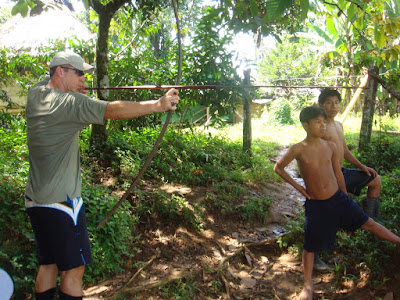
On the river bank we met some BriBri boys who wanted to teach us how they shoot their handmade bows and arrows. These handsome kids had such beautiful smiles and manners, it was a pleasure to watch them shoot the target (hanging fruit) and then let us take turns.

Dan’s dad was a national champ archer and taught Dan to shoot when he was little, so I wasn’t surprised when Dan’s rudimentary arrows grazed the target several times. The girls took aim too, and I was proud of them for trying—Erin said it was very hard.
Tasting monkey tails
By this point our stomachs were growling, so we returned to the lodge for a typical, delicious Bribri meal. We had the chicken we saw cooking earlier, fresh palmito, rice and beans, plantain and banana, and fried monkey tail (remember the plant we’d seen earlier on the trail?). Large banana leaves lined the serving bowls and covered our plates which were actually smooth, thick slabs of wood. Nobody was shy about taking seconds and even thirds, we were so hungry and the meal tasted great.

A lesson about the Bribri
Daisy, a BriBri Indian, taught us more about her village. Years ago, the Yorkín women united to form the indigenous association Stibrawpa, intended to diversify their means of production, particularly agriculture, and develop new sources of income while preserving their culture. It’s interesting that while the men are involved in decision-making for the Bribri, the women lead the village council and have directive control.

Now several Bribri families in the association grow a variety of crops as sustainable agriculture and also sell organic bananas and cacao, and the women create indigenous handicrafts for additional income.

Daisy explained to us that they have no medical care, but a doctor comes by every couple of weeks. Additionally, while the government has offered to bring electricity to them, they don’t want it; the concern is that it will drastically change their way of life for the worse and lure their children away from the culture they’re working so hard to preserve (an effort that includes Bribri language courses for the kids). They do have a couple of cold-water showers and two toilets near the lodge, but make no mistake that these people live very simply and rustically.

The Bribri live in small houses with roofs made of traditional palm thatch from primary rainforest. They sleep in hammocks or on the floor, with everyone in the same room. Some houses are isolated and the children have to walk a long way—even an hour or two—to school.

What most struck me was that these are happy, peaceful people. They work very hard for their survival but seem cheerful and content with their lives. They care for their environment, their families, and showed a genuine kindness to us. Despite the seemingly insurmountable differences in language, upbringing, and culture, I felt a connection to these women and great admiration for them. It was yet another lesson I’ve learned in Costa Rica about perspective in life.

Making chocolate
On to the most anticipated part of the day … making chocolate from the cacao, which is sacred to the BriBri. We learned how cacao seeds are dried and then toasted. The warm seeds tasted like bitter chocolate. A young man brought out a smooth, heavy stone and showed us how to crush the seeds with it. It’s a lot harder than it looks! And wow, the seeds smelled really good when we crushed them.

Once everything was in tiny pieces, he rapidly shook the bowl to separate the meat from the shells. Then he put the cacao into a hand grinder and everyone took a turn with the handle. What came out and into the bowl looked like thick, melting chocolate. A few of us couldn’t wait and dipped our fingers in for a taste. It was bitter but absolutely chocolate.

We took the chocolate inside the lodge where some of it was mixed with hot water and sugar to drink—a traditional BriBri-style hot chocolate—while the rest was combined with a can of sweetened condensed milk. Oh my gosh, please, this was absolutely some of the most amazing chocolate ever. Thankfully we are all good friends because most of us (especially Isa, Erin, and I) were dipping our fingers into the sweet chocolate, licking them off (all while animatedly discussing the deliciousness of it all) and then diving back in. True dark chocolate is considered to be about 50 percent cacao; we were eating 100 percent cacao (less when mixed with the milk). This was the freshest chocolate ever and wow, sooooooo good!!

The return trip
Late afternoon, we headed back to our boat and to Bambú. The river’s current was with us as we traveled downstream in the dugout, so the trip was considerably quicker than our first journey yet equally as beautiful.

It felt great to take off our rubber boots and long socks when we got to our cars. We said our goodbyes and headed back to Punta Uva with plans … everyone needed a shower (wow, were we dirty—especially Lauren!) and a rest, and then we’d meet up for our 7pm reservations at La Pecora Nera. Yep, again—because after our day—we made it!—we decided to enjoy the luxury of a fantastic, candlelit Italian dinner at a beautiful restaurant with our wonderful friends. We are truly blessed to have met the Muelases and spent this unique experience with them. It was a day none of us will ever forget and one that left a lasting impact on our lives.