Sunday, May 18, 2008

Ribs and cake (aka: basketball injuries, part two)

Yesterday, Dan joined a bunch of guys from the office to play basketball for a company program encouraging everyone to get active and be healthy. The games were held in Escazu at a local gym. It was fun to visit with friends and see the brightly painted floor, the refs in their blazing orange shirts, and the scorekeepers flipping papers with numbers on them for the score.

That was the good part. The bad part—other than Dan’s team getting walloped—was that basketball is just not a big sport around here, and most of the guys on the court didn’t seem to have much experience. This led to some amazingly wild passes soaring through the air and, unfortunately, a lot of elbows and bodies flying too. And not much refereeing!

I told Dan before we left for the gym that my goal was to avoid a trip to the ER at the hospital. We managed that, but halfway through the game I saw Dan sitting under the basket pleading with the ref for a call. I knew he was hurt when he got up and didn’t have his usual spunk—and sure enough, he injured a rib again (on the other side this time).

Erin felt sorry for her dad, so when we got home she baked him a cake from scratch in hopes that he’d feel better.

Thankfully this morning the rib is just sore and it’s not nearly so bad as last time, but I told Dan that his days of b-ball in the land of flying elbows are over.

Thursday, May 15, 2008

Pump it up

We now have a constant supply of water here at our Costa Rican casa. Yippee! The last water outage spurred me into action: I spoke a few times with the landlords’ representative and explained the situation, and eventually they agreed to pay the nearly $1K to have a pump installed. What a relief!

We have a tank under our driveway (we’d always wondered what the metal lid was covering), and a plumber came out to drain it, sanitize it, and fill it. It has a lift arm and float, just like a toilet—which I excitedly pointed out to the plumber (as if he didn't know, oh, and I'm sure he was highly impressed that I knew the Spanish word for toilet).

Once the tank was filled, the guy installed the small pump next to the hot water heater. This made a huge mess in my storage room and laundry room—there was water everywhere. I wasn’t too upset though, mainly because I was giddy with the thought of taking a high-pressure shower and not having it wane to a trickle, and there are also drains in the floors making it easier to clean. (Thank goodness, since the sink the washing machine hose empties into overflows frequently because the hose pops out of the drain—but that’s another story in itself).

On Tuesday, the construction foreman stopped by the house to let me know the water would be turned off for a couple of hours. I gave him a big smile and told him it is No Problema here because of our shiny new pump. Sure enough, I soon heard the pump spring into action and I happily went about my day without a water worry.

¡Pura agua!

Wednesday, May 07, 2008

Swimming for Sports Day

It was so good to see my girls swim competitively again—even if only for one race.

The kids recently had Sports Day at school, complete with an opening ceremony and pledge, indoor events, track and field, and relays at the pool. All the elementary school kids participated in at least one event, and (not surprisingly) my two were chosen to swim. (A few kids were missing from Lauren’s class, so she also did a free throw shoot and something else which I didn’t get to see and can’t remember what it was.)

Sometimes cultural differences are glaringly obvious to me at school functions, and this was no exception. Guess which parents were sitting on the side of the pool, socializing quietly as they watched the kids? Well, certainly not the Americans. No, we were the moms and dads at the end of the pool (for the best view, of course) enthusiastically cheering the kids on. We weren’t obnoxious, but I will admit, we US moms and dads are generally a spirited, competitive bunch.

After all the games and races the kids got medals—bronze, silver and gold. They’re not even cheesy and have the school logo on one side with the event and date on the other; they are great mementos for the girls.

Sunday, May 04, 2008

Look who’s eight!

It's just Lauren’s luck that May 1 is a national holiday—Día de los Trabajadores (Labor Day)—here in Costa Rica. Meaning my brand-spankin’-new eight-year-old had a day off from school on her birthday. What a fun twist of fate!

Lauren, Erin, and L's classmate Isabel—her best amiga and partner-in-crime—spent the day together to celebrate, starting with lunch at Wendy’s. (This was the birthday girl’s choice, of course, because what better meal is there than chicken nuggets and fries for a kid turning eight?)

Next stop was Go Bananas, an indoor playground just a couple of kilometers from our house. This drop-the kids-off facility has plenty of space for the girls to run and climb, so I left them to play while I parked myself in a cozy, padded armchair with a drink and a novel outside one of my favorite restaurants, just around the corner from the playground.

Lauren’s teacher stopped by for lunch shortly before I was leaving to pick up the girls. She asked us to come back and say hi, so I told the girls I had a surprise for them as we made our way to the restaurant. Of course Lauren got a big hug from Ms. Fernández, and she and Isabel acted all goofy when they saw their teacher outside of the classroom (yes, teachers are normal people too!), while Erin was just relieved that her teachers were nowhere in sight on vacation day.


Everyone enjoyed homemade birthday cupcakes at our house (we sang two lovely renditions of the birthday song in English and Spanish), and then the girls went swimming so Lauren could try out her new goggles and float.

We were worn out by the end of the day, and everyone got to bed early since the kids still had school on Friday (and I did too, since I was chaperoning a field trip). We missed having Dan here—he’s in Cincinnati for work—but Lauren says her eighth birthday was still just ducky (her word, of course).

As I’m sure I say every year, it’s hard to believe my baby is getting so big! ¡Feliz cumpleaños, Niña!

Friday, May 02, 2008

Fish out of water

Fair warning: I'm cranky, and so are my kids. Even Lauren, and that's saying something.

I've got all sorts of nice, cheery things to blog about—and I'll have to do it another time—but tonight the only thing on my mind is that we have no water in our house. Again. Yesterday we didn't have water until nearly 3:00 in the afternoon. (Around lunchtime I gave in and took a shower at a friend's house.) Today I got up at 5:00 to take a shower, do a load of laundry, and clean up the kitchen before my busy day was underway. No water—at 5:00 in the morning!

I had to feed the kids, make lunches, and get out of here by 7:30 because I went on a field trip with Erin's class. Thankfully I had set enough water aside to wash my face and take a sponge bath, but now, it's 8:30 on Friday night and we have zero agua. Nada. The whole neighborhood is out of water, and I've got a guy coming tomorrow to see if he can install a pump so we can avoid this happening again. (I’m pretty sure the homeowner is going to consent to having this done, thankfully.)

Meanwhile, I'm jonesing for a shower and crossing my fingers that the pipes will start gurgling soon and we can cook, clean, shower, flush, wash, and all those good things by the morning.

Isn't it ironic, since I just mentioned a couple of posts ago how this happens frequently enough and I usually roll with the punches? Not this time. It appears I've reached my breaking point, and while I know there are worse things in the world, I feel justified in venting my pent-up frustrations. Dan's not here to fuss with/listen to me, so the blog is tonight's therapy session. Thank goodness we still have electricity!

Oh, and as a parting shot, it is raining outside. Not enough of a downpour that I can run to my yard with a bottle of shampoo and a bar of soap, but enough to tease us all with fat drops of water on the windows. Bah!

Sunday, April 27, 2008

Road rash

Temps this week have been the hottest we can recall in the valley—ideal days for swimming. Unfortunately for Erin, she came home from school on Thursday with big, blood-stained pads of gauze taped to both knees. The kids’ school is built on the side of a hill, and Erin was heading down a concrete sidewalk when she wiped out. Both knees have two nasty scrapes (and this picture is three days later; thankfully the knees are starting to look better).

Of course there’s no way we’re letting her in the pool, even with the bandages on (I’m so glad I bought the box of super-large Band-Aids last summer). The ban on swimming was really the pits yesterday when Erin’s friends were visiting our neighborhood pool. Dan and Lauren went to swim while Erin and I made cookie bars for this week’s lunches.

Nothing like a warm chocolate chip treat (yes, we splurged on pricey chocolate chips—hey, desperate times call for desperate measures) out of the oven to soothe what ails a 10-year-old.

Thursday, April 24, 2008

Facing frustrations

“The reasonable man adapts himself to the world; the unreasonable one persists in trying to adapt the world to himself.” —George Bernard Shaw

“But what if a reasonable person is trying to adapt to something unreasonable?” —Me

A friend told me that in the United States one dies of stress, while here in Costa Rica one dies of frustration. We laugh about it, but there is a grain of truth to this notion. While life is markedly more hurried at home, here it’s important—if one wants to maintain some semblance of sanity—to adjust to the slower culture and adopt a more tolerant, patient attitude.

Accustomed to the efficiency of the US, I get frustrated at having a dishwasher sit on the kitchen floor for two weeks while construction workers show up at random to fix the hole in the wall—you know, the hole where the dishwasher connects to the plumbing that was installed five centimeters too high according to the plumber?

Adapting is going for nearly an entire weekend without water, which is what just happened to us—and not for the first time. Costa Rica runs on hydroelectric power, and apparently the water is sometimes shut off during the dry season to help avoid brownouts (which we have also experienced). In the US, I’d be on the phone with the water company trying to find out what’s going on and how quickly water service will resume. Here, the idea of calling with that question is nearly laughable. The water will go on when it comes on, and we just go with the flow (or lack thereof).

Remember our waiting list for a landline telephone? We’re still on the list. We honestly do not think we will ever have a landline while we are living here. I don’t like it, but I don’t dwell on it, even though cell phone service is spotty. See how well I’m adjusting?

The ultimate in aggravation is surely the lack of maps and street signs in this country. And knowing that you could stop and ask for directions and, because a Costa Rican does not want to hurt anyone’s feelings or be unhelpful, the directions you receive may be wrong.

Just when I think I’ve truly embraced the Pura Vida lifestyle, something happens—not even necessarily maddeningly frustrating, it could be something minor—and the dam of built-up frustration bursts, while my all-American self comes shining through. I share what’s bugging me with Dan or an American friend in Costa Rica and we shake our heads, commiserate, and eventually laugh at the absurdity of it all. Culture shock isn’t always the extreme sense of anxiety you might imagine; in fact, it happens routinely here to us as we go about our daily lives.

Monday, April 21, 2008

Pruning the palms

When running through our neighborhood, it’s tempting to seek shade in the palm trees' shadows and out of the hot sun; yet we know better. On windy days, we occasionally hear a crash outside our house as a heavy, dying palm branch plummets to the ground—and we’re always glad nobody was below the tree when the frond fell.

Thankfully, the gardeners come by once in a while to prune the browning fronds from the trees. The palms are tall, so the workers have rigged an ultra-long pole with a blade securely attached to it with tape. With the blade, they remove the menacing fronds just waiting for a gust of wind to blow them down.

By the way, we are at the end of the dry season and just heading into rainy season; you can see how the grass in the field is just starting to get a little green. Soon everything will be lush and beautiful (and wet!).


Thursday, April 17, 2008

Colas, sodas, and what’s on the menu

Here’s a little tidbit about eating and drinking in Costa Rica, with a Spanish lesson thrown in for fun.

If you’re looking for a bubbly beverage here in ticolandia, don’t ask for a cola. In Costa Rica, a tail—whether on an animal or a ponytail in the hair—is called a cola (sounds just like the cola you drink).

Perhaps you could order a soda? Not here. A small restaurant that serves traditional, inexpensive Costa Rican food is called a soda (yep, sounds just like the soda you drink). These little sodas are all over the place, even in remote areas of the country where one wonders how the soda gets its supplies and who is eating there. Anything but fancy, sodas often are sometimes just simple support structures with tin roofs or tarps overhead, as you can see was the case at Soda El Mango where we had lunch on a Manuel Antonio beach.


Sodas serve comida típica—typical/traditional tico food—which relies on local agriculture and cultural tradition. These very modest eateries sometimes don’t even offer menus to diners since it’s known they serve native dishes.

Typical tico dishes such as gallo pinto (a mixture of rice and beans) and casados are the norm. Casado means married, and casado plates are marriages of food to make a meal: rice, beans, a salad of some kind (perhaps heart of palm or cabbage and carrots), fried plantains, and some kind of meat or poultry. My favorite soda food is chifrijo—a combination of chicarrones (fried pork), frijoles (beans), rice, pico de gallo and some other yummy stuff that tastes fantastic.

Eating at soda is a great way to immerse oneself into the tico culture while getting a filling meal at a fair price.

So what do you ask for if you’re thirsty? A carbonated beverage is most often called by its actual name: Coca (for Coca Cola), Coca Light, Fanta … you get the idea. There are oodles of fruit juices here. Coconut milk—sipped from a coconut through a straw—is sometimes sold along well-traveled roads. And of course coffee is king in Costa Rica.

Our favorite drinks are the refrescos—sweet, satisfying concoctions made of liquefied, fresh fruit blended with either water or milk. These traditional drinks are available in loads of flavors such as watermelon, mango, strawberry, blackberry, tamarind, passion fruit, guanabana, and cas. Our favorites are watermelon and strawberry.

If you’re brave enough to try something that really packs a punch, sip a bit of guaro, the national liquor of Costa Rica made from distilled sugar cane.To minimize production of bootlegged guaro, the tico government nationalized the manufacturing of the stuff with the Fabrica Nacional de Licores-Fanal, offering Cacique, the only legal brand of guaro, since the mid 1800s. Just don’t become a guaro vaquero (guaro cowboy)—someone who’s had too much too drink and acts like an obnoxious fool!

There are plenty of other drinks available here in Costa Rica, but perhaps the best news is that you can safely drink tap water here, which is not the case in many Latin American countries. It's freeing not having to worry about what's in the water and makes eating and drinking much simpler.

Cheers!

Wednesday, April 09, 2008

A sense of belonging

Recently I was standing in the checkout line at a supermarket near my house. The employee who was scanning my groceries recognized me and greeted me by name, which made me smile.

As I waited for her to tally my purchases, I began singing quietly to the song playing in the store. Before long I wasn’t the lone vocalist, and I turned to grin at the guy next to me—a tico with flamboyant clothes and a faux-hawk who owns the salon a few doors down and occasionally cuts the girls’ hair. He has a very cute little dog named Paris who runs around the strip mall and is so fashionable he gets his tail dyed—usually pink or light orange. The kids love to see Paris and we usually stop for a moment to tell him hello or give him a scratch behind the ears.

In line behind the hairstylist was my beautiful, friendly pharmacist who is always helpful and lets me speak Spanish with her even though her English is excellent and I sometimes fumble with unfamiliar medical terms.

So there I was, sharing a friendly connection to all three people around me. I am part of my neighborhood; I am recognized. This is my home away from home, and while I have made some special and invaluable American friends here, it feels really good to have established relationships with ticos in my community.

Sunday, April 06, 2008

Manuel Antonio in March

Our first spring break destination outside the valley was Manuel Antonio—both the park and the town. We visited the park last Thanksgiving, and it was so amazing we had to take my parents there, too.

Our lodging was a private villa on a cliff with a breathtaking view of the Pacific Ocean, framed by a canopy of trees that’s home to tropical birds, sloths, monkeys, and lizards. We enjoyed relaxing on the deck and listening to the surf as we soaked in our surroundings.

During our stay at the villa, my parents got a taste of authentic life in Costa Rica. Their suicide shower wasn’t working until the last day of our visit (after a handyman came to replace it) and the power in Manuel Antonio went out several times—once while we were dining out (thankfully by candlelight). These snags, which would be unexpected and unacceptable in the US, are common here and a reminder that we live in a developing country.

Boogie at the beach
To get to the beach—just a half mile from the villa—we drove down a path of indescribably rough terrain (four-wheel drive required!) and parked on the sand at the bottom. I’ve never felt ocean water at such a perfect temperature, and swimming was a welcome activity each afternoon since Manuel Antonio is hot and humid at this time of year. Dad rented a boogie board, and nearly all of us had a go at wave riding.

Horsin’ around
Our first night we ate dinner at a large, open-air place in Quepos called El Gran Escape (The Great Escape), which, in its former life, was both a brothel and a cervecería (place to buy beer). An authentic tope—or horse parade—was happening in the main street just outside the restaurant. In this festive atmosphere, Costa Ricans proudly display their high-stepping horses while others cheer them on and music plays.

Manuel Antonio National Park
Sunday was spent at the national park. We arrived early to avoid crowds, see the animals before their afternoon siestas, and enjoy hiking before the equatorial sun blazed too hot. The last time we visited was at the end of the rainy season when we crossed the water in a boat to reach the park; this time, nearing the end of the dry season, we walked through hot sand to reach the park’s entrance.

We loved showing Mom and Dad what we’d learned on our last visit, and it was great to see some new things too—like the tell-tale turtle tracks on the beach that Dad spotted. We also tackled a new, more difficult trail for hiking: Punta Catedral (Cathedral Point), an outcropping of land that was once an island but now connects to the mainland by a natural land bridge. This hike of about an hour took us up a steep incline through dense jungle. It was a challenging (and sweaty!) climb, but it was so beautiful and unique, it was worth it—especially when we saw the view of the ocean, far above the surf pounding rocks below.

More monkeys
We saw plenty of wildlife on our trip, both while in the park and elsewhere. A highlight was the huge troop of squirrel—or titi—monkeys as they migrated past our villa early one morning. These fun little monkeys are incredibly cute as they swing through the canopy, gripping branches with their tails and then launching their small bodies to nearby trees. They’re also a vulnerable species, so we felt very lucky to see so many—including a few mamas with their babies firmly attached to their backs. Many monkeys ran across the roof of the deck, and one peered over the edge to get a closer look at us. (A capuchin monkey had done the same thing the day before, with his eye on Erin’s ginger cookie!)

While we heard howler monkeys several times throughout our travels, these noisy creatures did not wake us in the middle of the night with their roaring, as they did on our last trip to the area.

Isla Damas
On Monday morning, we toured the protected inland waterways of the Damas Island estuary. We traveled with our knowledgeable guide Eduardo to the sleepy town of Isla Damas, just north of bustling Quepos. There we boarded a canopied boat for a morning trip through a unique ecosystem nestled in a lush mangrove forest.

We made our way through a maze of narrow channels of brackish water surrounded by amazing African palms, loads of plants and trees, and impressive red and black mangroves. We saw a variety of marine birds, crabs, lizards, and even the rare-to-spot silky anteater napping in a tree. But the best—no surprise here—were the playful monkeys who came right up to our boat and jumped on the roof, let us touch their hands, and provided fantastic entertainment for their human guests.

Valley bound
After three nights, we left tropical Manuel Antonio for Santa Ana. The ride home was scenic and uneventful (always a blessing!), and we were glad to return to the cool, breezy valley we love.

Click here to see a photo album of our trip (best viewed as a slideshow). ¡Pura vida!

Thursday, March 27, 2008

Zip-a-dee-doo-dah

Many thanks for the emails asking where we’ve been, if I have writer’s block, and whether I've just been too busy sunbathing to post even the measliest of blogs. I appreciate the concern and am happy to share that my absence from writing has been for the best of reasons—we were enjoying a fantastic, adventurous, amazing (and yes, a wee bit exhausting!) two-week vacation with my parents. Plenty of fodder for blogging, so stay tuned for a few tales of our journeys.

That said, I already know exactly where to jump in with a story, because the following is the adventure most likely to surprise those who know me (and my fear of heights!) well. This journey actually occurred later in our travels, but who says everything has to be in chronological order, anyway?

Last week the six of us drove to the imposing Volcán Arenal (Arenal Volcano)—a massive, conical volcano (the most active of the nation's volcanoes) that rises up from the San Carlos plains in the northwestern part of Costa Rica. You can’t drive to the top of Arenal and look at the crater because it’s constantly spewing gases, ash, and molten rock. At night, if you’re lucky, you can see the fiery rock spilling down the side of the volcano. Unfortunately we were on the other side of the volcano and didn’t experience this (maybe next time!), but seeing nearly all the volcano a few times (when it was not at least partially obscured by clouds) was incredible in itself.

While at the foothills of Arenal we stayed at Los Lagos, a resort with large grounds reminiscent of a botanical park—the trees and flowers of this area are varied and spectacular. The resort also featured a great view of Arenal, a hot springs pool (ahhhh, that was so nice!), a couple of regular pools with some fast waterslides, a crocodile farm, butterfly garden, horseback riding … and a zip line.

If the term zip line is new to you, here’s a quick overview: On a zip line—also known as a canopy tour—a series of cables is mounted from tree to tree, on an incline, and there is a platform at the end of each cable. A rider wears a harness around the waist and legs, which is secured to a pulley suspended on the cable. The rider then takes off from the platform (usually just by stepping off) and glides—propelled by gravity—from one platform to another, flying over trees and through the canopy itself.


Though three of the six of us (my dad, Erin, and I) are afraid of heights (perhaps putting it mildly for at least Dad and me), we decided this extreme sport would be an unforgettable adventure we could all share. Carpe diem—a chance to make our lives extraordinary! So we signed up for the zip on Thursday and headed out for the plunge on Friday morning.

At the start of the zip line, we were each outfitted with a harness, a helmet, and a leather hand-guard/glove. I was pretty sure the helmet was in case a branch fell on my head, because it wouldn't have helped much had I gone plummeting to the ground far below, but I didn't dwell on that or I would have made myself nuts.

We rode part way up the side of the mountain in a van and exited at a little station with a short cable. The lead instructor taught us how to ride the line and how to brake (nobody wants to smash into a tree, a la George of the Jungle), and after a short learning session it was time to go! The good news is that the first zip line started at ground level and took us down the mountain slope, so there was no need to climb an intimidating tower, which was my greatest fear and which I still think may have stopped me from ever doing the zip.


The zip line we went on had 15 cables and 16 platforms, with distances varying from 50 to 500 meters, for a full distance of three kilometers (1.86 miles)—oh, and reaching speeds of up to 80 kph/50 mph. The zip was strung above and throughout the tropical rainforest, dense and wild and absolutely gorgeous; Lauren even saw monkeys on her zip. We were part of a large group, and Lauren was the first to go. Pigtails flying in the wind, she rode with the guide and had a blast the entire trip. Shortly after, Erin took off. She was the youngest in our group to go by herself. Wow, I was so proud of her! Then Dan jumped, then me, then my parents.

Soaring through the air above the treetops on this high-wire ride was an adrenaline-pumping rush that’s hard to describe. At times I was able to take in what I was passing as I whizzed through the sky, while at others I was rocketing past towering trees at speeds too quick for me to see much of the tropical rainforest below, mouth agape as the reality of what I was doing sunk in. Oddly enough—and this is the honest truth—I never experienced the paralyzing fear I was concerned about. Maybe the adrenaline is what saw me through, maybe it was the agonizing thought of returning to the United States to the ridicule of “You lived in Costa Rica and never did a zip line?!?!”—but I did it. We all did it—the girls, Dan and me, and my incredible parents of whom I was so proud.

Thankfully for us (and I suppose you, if you’re up for it) the zip line company stationed a photographer throughout the zip so we have pictoral evidence of our high-flying thrill ride. Enjoy the photos (best seen as a slideshow); they will always remind me of the day I met a daunting challenge head-on and shared a wild adventure with those I love most—and lived to blog about it.

Wednesday, March 05, 2008

Gracias por la música

I went shopping today at Hipermás, a large department/grocery store (owned by and similar to Wal-Mart yet not as inexpensive, unfortunately). Shortly after I got there, I stopped to listen to the music playing overhead, trying to make out the words of the all-too familiar song. It was ABBA’s Chiquitita—but in Spanish.

I knew ABBA had done several recordings in Spanish, and today was my chance to listen to them, since they played the entire time I browsed the aisles. I heard Thank You for the Music; Dancing Queen; Gimme! Gimme! Gimme!; Fernando; I Have a Dream; Knowing Me, Knowing You … I wish the girls had been with me, they really would have enjoyed it.

¡Pura música!

Monday, March 03, 2008

The shortage ends (and why expats love stuff from home)

Do you recall the dreadful mac and cheese shortage that recently swept Costa Rica? I’m pleased to share with you an update on the status of blue boxes here in the valley …

Our friends David and India called us after church yesterday with the news: there was one precious pallet of Kraft M&C in at PriceSmart. Yippee! They kindly bought 30 boxes for us (we just couldn't ask for more!), and we intend on a trip to the store soon in hopes of finding another couple dozen.

Shortly after we returned from a relaxing Sunday afternoon at the pool, David arrived with the blue boxes. Dan promptly rescued two of them from their shrink wrap and made dinner—and it was delicious.

In other food news, I recently purchased brown sugar for the first time since we've been here. I had been making do with azúcar con caramelo (sugar with caramel, basically) which was not bad, but my cookies and baked goods just didn't taste quite the same or have that perfect consistency. I didn't know if I'd ever find brown sugar here until a friend told me it is possible, but difficult, since it's rarely in stock. Yet there it was last week, unassumingly sitting on the shelves as if it had been there all along. I bought numerous boxes, but two are already gone. How long will brown sugar keep, anyway? Because I'm planning on getting a whole bunch more while the getting is good.

Think we're crazy? That we’ve completely lost our grip on reality since moving south of the border? This enlightening piece by expat Pamela Druckerman explains how valued American goods can be to those so far from home. Funny thing is, I hadn’t read this article since it was first published—right before Thanksgiving—and now I see that Kraft Macaroni and Cheese and brown sugar are both mentioned in the text. How validating!

It’s true that expats thrill at the thought of jamming suitcases full of products straight off the shelves of Target and Wal-Mart and lugging the stuff back to their adopted countries. Those people visiting expats are lovingly (yet eagerly!) considered as pack mules. My parents will be here soon and have a list of goodies to haul—from two Nintendo DS games for an American friend of ours to sugar-free Tums, peanut M&Ms, Gain apple mango tango dryer sheets, and packets of Taco John’s hot sauce if they can get them (oh please, we're begging!). We are more than excited to see Mom and Dad, but I’m sure soon after they’ve settled in we’ll be asking, “Where’s the stuff?! Did you bring the Reese's Pieces???”

Wednesday, February 27, 2008

Lost in translation

Sause on pork shop? Sound tasty? This is Erin's favorite goofed up translation, found on the menu of a traditional Tico restaurant near Poás.

It’s common to find mistakes in the English translations that occasionally appear on menus here. The one I've seen most frequently is "jam" meaning "ham," since the j sounds like an h in Spanish. Toasted jam and cheese sandwich, anyone?

Last Saturday, I bought Crismelos, a Costa Rican brand of marshmallows, to use in Rice Krispies treats for the kids. While many packaged food products from Central America do not include preparation directions, Crismelos has gone beyond the call of duty and offered a recipe for "Crismelos Chocolates" on the back of the bag—in both Spanish and English. The translation is amusing:

"Melts the chocolate bars in furnace of microwaves, immediately removes the cup from the furnace, right away introduced the Crismelos in the chocolate one by one. Placed in pyrex and put the refrigerator."

Furnace of microwaves? I'm not sure my average microwave is up to the task!

Moving on, here's another favorite Spanish-to-English translation. Found on a map of Sarchí, a town recognized for its beautiful wood-working and traditional oxcarts, this gem appears next to its Spanish counterpart in bold, capital letters:

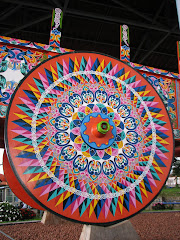
This is a Costarican art monument, artesanal jewel and artistical. It is a national symbol and it was declared as intangible patrimony of the humankind by UNESCO on November 2005. The craddle of the Costarican handcraft Sarchi realized this emblematical oxcart. It was created at the historical Eloy Alfaro and Sons Workshop, built and painted in 3 months whit the supporting of 3 painters and 3 crafters. The oxcart is 20 meters lenght and 3800 inches of bitter cedar and laurel.

The snippet about the “intangible patrimony of the humankind” is priceless. While part of me desperately wants to edit the English on Costa Rica’s menus, maps, and brochures, the rest of me appreciates the levity of such delightfully funny renderings.

¡Puras palabras!

Monday, February 25, 2008

5K Day

The 25th anniversary CDS fun run was this weekend at the girls’ school, and Dan ran the hills of Escazú on a sunny yet cool morning. Our friend Gabriel also ran the race, and I chatted with his wife Isa and their little ones while the guys ran. Erin and Lauren had fun wandering the school grounds with amigas and cheering for their dad.

Saturday, February 16, 2008

The blue box blues

When mama wants to please me
she's only got to cheese me!
I got the blues ...


A minor crisis has struck our household in the form of what appears to be a country-wide shortage of Kraft Macaroni and Cheese. Yes, the marginally nutritional, unnaturally orange, yet unfailingly comforting and homey pasta dinner in the blue box. Can't find it anywhere—not even at the big warehouse club down the highway. I open the kitchen cupboard and see that empty spot where the mac and cheese normally resides, and feel a pang of despair. In a country with extremely little in the way of frozen or pre-prepared food, we've come to rely on Kraft mac and cheese for an easy Sunday supper or a snack to fill hungry bellies.

Here's the thing: One can never count on anything imported from the US to be in stock. A month ago I needed a basic antibiotic and was told at the pharmacy that it was unavailable and I wouldn’t find it in any pharmacy in Costa Rica. I asked for a substitute and got one, no problem. (A side note: you don’t need a prescription for many drugs in CR, including antibiotics.)

Another example … When we first moved here, I bought a couple of cans of Campbell's tomato soup, because it's my favorite and Lauren loves it, too. It costs twice as much as at home, but it was a splurge we were willing to make.

Next trip back to the store ... no Campbell's tomato. Cream of mushroom, chicken noodle, a stray can of Manhattan clam chowder, sure. But no tomato.

We tried other kinds of tomato soup, but nothing fit the bill. I was disappointed until—several months later—there they were! Four cans of tomato soup wrapped in familiar red and white labels. Not to be fooled again, I bought all four cans. This last week there was an impressive stock of the stuff. Why? I have no idea. Sometimes stores carry a lot of a certain import and then it will disappear off the shelves for weeks to months at a time.

Sadly, the mac and cheese has vanished. We buy it in bulk at Pricesmart, and all four of us stood dumbfounded and stared at the shelves last Saturday when we realized there was no mac and cheese. What's the deal? Are the Americans hording all the mac and cheese, creating increased demand for the stuff and causing this shortage here in Central America? (And if so—hey, knock it off!)

We'll play the waiting game, and at some point I expect we'll stock our makeshift food storage room with a case or so of Kraft Mac and Cheese. Until then ... we've got the blue box blues.

Monday, February 11, 2008

The big bucket in the sky

Not long ago, Lauren went to a friend's house after school to play. Shortly before dinner, I drove (with Erin in tow) to the friend's house (through harrowing rush hour traffic, I might add!) to retrieve the little one. I had met the father of Lauren's friend, who works for the US embassy, but never the mom, so we sat down for a few minutes and enjoyed chatting while the kids finished making their sock puppets.

As we were talking, I learned that the father, John, is from Lexington, Kentucky. About 15 minutes later, I finally mustered up the nerve to ask about the large portrait hanging on the far side of the family room and dining room. "Uh, is that really a painting of Colonel Sanders?"

Yep, it is. Colonel Sanders was John's great-great grandfather. Later, within five minutes of leaving our friends' place, we drove past a KFC. Erin wondered, "Do you think they get a discount?"

I should have asked if he has the secret family recipe with eleven herbs and spices!

Tuesday, February 05, 2008

Goodlight is great news

Books in English are a hot commodity. We brought most of our books with us and have been rereading page after page, because buying new books in English is not in the budget: a $7 paperback in the US goes for $14 here. I crave new reading material and sorely miss trips to the library. When we return to the US, I'll be spending hours poring over all the lit I've missed during our time in CR.

Frustrated with reading the same old stuff, I began the search to borrow books from other Americans. And then, through an Internet group of expats living in CR, I learned about Goodlight Books. This great little shop is unpretentiously sandwiched between typical Tico locales, but it's a true gem for bibliophiles: it's a bookstore selling used books in English at reasonable prices.

Once I'd heard about Goodlight, I’d planned that we'd stop there on the way home from our trip to Poás. The shop is in Alajuela, about a 20-minute drive from our home in Santa Ana.

We found the store with little trouble (not always an easy feat in no-street-signs Costa Rica) and happily plunked down about $50 for at least 30 books (I lost count somewhere along the way). The shop owner was very personable, the selection of material beyond adequate, and I even got to pet the resident cat, Chola, who was hanging out on the top of the computer desk. Wooohoooo! We've got plenty to keep us reading, now!

A book is like a garden carried in the pocket. ~Chinese Proverb

Friday, February 01, 2008

Day trip to Poás Volcano

On a sunny Saturday, we set out to visit Poás Volcano—the silhouette of which we can see from our house (though it looks just like the other mountains around us). Our drive took us through the nearby town of Alajuela and then skirted a few smaller towns, such as San Pedro, Fraijanes, and Poasito. (Click here for photos of our day.)

On our way we were treated to green, lush vegetation, including trees bursting with vibrant orange and deep purple flowers. We saw a waterfall rushing down a mountainside, a large crop of sugar cane, coffee plantations, and field after field of what we’ve been told are ferns, strawberries, and even coffee growing under massive, ventilated tarps.

We stopped for a few photos as we ascended; we could see the Central Valley and all the tarps from higher up the mountain. Our ears were popping and we had to put the windows up on the Rav4, because the temps dropped quite a bit. (You can get cold in sunny Costa Rica!)

After about a 90-minute drive we reached Poás National Park. All visitors are asked to park their cars facing out, in case there is need to evacuate. Thankfully the volcano didn’t blow its top while we were there. (I believe the park was last closed to visitors in the 90s when Poás was spitting out too much gas.)

We hiked a bit until we reached the highlight of the park—the active crater. At a 1.5-kilometer diameter, this active crater is reportedly the widest of any volcano in the world. The crater has a steaming, blue-green lake. (The lake’s color changes frequently; when we left CR on our trip to the US, the pilot flew over Poás and the color of the lake was much more intense than it appeared on this visit.) Though we just saw a few bubbling emissions of sulfuric gas—which we could smell, as well—the volcano is known to have huge, geyser-like eruptions.

As is typical for Poás, there were clouds that rolled in and over the crater. Thankfully they were thin and dissipated quickly so we had great views of the entire crater and surrounding area. We were grateful for the sun’s warmth, because in addition to the cooler mountain temps it was extremely windy at the overlook for the active crater. At one point, Lauren sought refuge under an observation stand just to get a break from the gale. We knew enough to wear pants and bring jackets, but saw some people in shorts, T-shirts, and flip flops. I wondered if they realize the gift shop sells jackets.

We backtracked just a few yards down the trail from the active crater to a 1.5-kilometer trail leading to Botos Lagoon. This hike was uphill most of the way (in high elevations—whew!) but led us through a very cool section of stunted forest. The park actually has great biodiversity and boasts four distinct habitats: areas with little vegetation (such as around the crater), the dwarf forest (made of crazy looking, twisted trees with gnarly roots), a cloud forest (very wet and dark with tall trees—this around the lagoon), and an area of arrayans (flowering, evergreen shrubs).

The dwarf forest and cloud forest were amazing; and yes, we did walk through several areas with plenty of canopy where wispy clouds hung around. Thankfully we all worse sturdy shoes, as the trail was slippery in places due to the humidity.


After about 30 minutes we reached the sparkling Botos Lagoon, a dormant volcanic crater filled with rainwater (yet still acidic). It wasn’t nearly as windy at this overlook, thankfully. Additionally, the lagoon overlook is the park’s highest elevation. Dan wore a GPS that shows feet above sea level, and as we hiked, Erin kept asking how high we were. The highest we remember seeing was 8861 feet, and I think the highest point in the park is 8870 feet.

Once we reached the end of the trail we’d hiked well over two muscle-testing miles of mountain. We stopped in the gift shop for a look around and shared a snack and some hot chocolate in the cafeteria.

Not long after that we began our descent and stopped near Poasito for some lunch. The girls had some sweet aguas naturales—water and ice blended with fresh fruit (Erin had strawberry, Lauren had mango). Lauren had a gallo de queso (fried Tico-type cheese on a fresh, corn tortilla) and the rest of us had typical Costa Rican breakfast (yes at about 2:30 in the afternoon) of scrambled eggs and gallo pinto. We were so hungry, it hit the spot. It was a nice lunch to cap off a fun day trip.

¡Pura Poás!